

Introduction
Qilin ransomware GlobalProtect VPN bypass attacks now show how quickly a perimeter appliance flaw can become a domain-wide ransomware event.
Arctic Wolf Labs investigated multiple June 2026 intrusions where attackers exploited CVE-2026-0257 in Palo Alto Networks PAN-OS GlobalProtect. The attacks started with unauthorized VPN access and ended with Qilin ransomware deployment across victim environments.
The campaign matters because GlobalProtect sits at the front door of many enterprise networks. When attackers bypass VPN authentication, they do not need to phish a user or steal a valid password first. They can enter through a trusted access path and begin credential theft, lateral movement, data exfiltration, and encryption.
This article explains how the Qilin ransomware GlobalProtect VPN bypass works, why CVE-2026-0257 became a ransomware entry point, what indicators security teams should monitor, and which fixes matter first.
For related ransomware defense context, see Digital Warfare’s BYOVD ransomware analysis on how attackers disable EDR before encryption
Why Qilin Ransomware GlobalProtect VPN Bypass Demands Urgent Action
Qilin is not a new ransomware threat. The group operates as a ransomware-as-a-service ecosystem and has been linked to high-impact attacks across healthcare, manufacturing, government, professional services, and critical business sectors.
The GlobalProtect campaign raises the risk because it combines three dangerous conditions.
First, the affected technology sits at the perimeter. Second, the vulnerability enables unauthorized VPN access when specific configuration conditions exist. Third, ransomware affiliates can use that access to move quickly toward domain compromise.
A VPN gateway should protect the network. In this campaign, the vulnerable gateway becomes the entry point.
That is why security teams should treat CVE-2026-0257 as a priority vulnerability even if their normal patch queue is already crowded.
What Happened: Arctic Wolf Links CVE-2026-0257 to Qilin
Palo Alto Networks published the CVE-2026-0257 advisory on May 13, 2026.
Rapid7 later reported observed exploitation beginning May 17 and published technical analysis on May 29. Palo Alto Networks also updated the advisory, raising urgency after exploitation became clearer.
Arctic Wolf observed increased exploitation activity in early June and later connected multiple June intrusions to Qilin ransomware deployment.
The pattern was consistent. Attackers exploited CVE-2026-0257, established unauthorized GlobalProtect VPN sessions, harvested credentials, moved laterally, staged payloads, and encrypted environments.
Some intrusions focused on rapid encryption. Others included double extortion, remote access tooling, and data theft.
That variation suggests multiple Qilin affiliates may be using the same initial access path.
How CVE-2026-0257 Enables the VPN Bypass
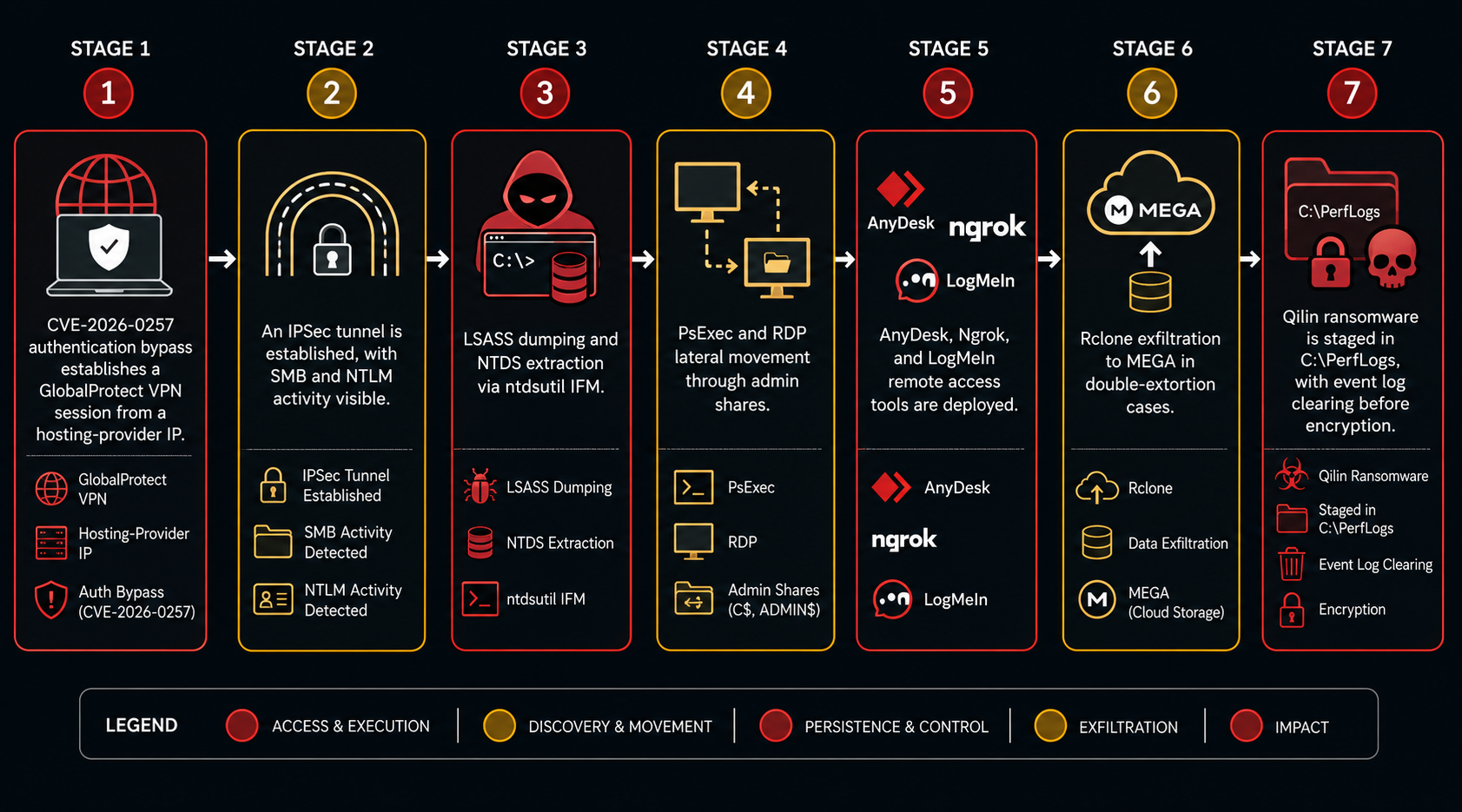
CVE-2026-0257 affects the GlobalProtect portal and gateway components in PAN-OS.
The vulnerability allows an unauthenticated attacker to bypass security restrictions and establish an unauthorized VPN connection when specific configuration conditions are present.
Arctic Wolf explains that exploitation requires GlobalProtect portal or gateway exposure, authentication override cookies enabled, and reuse or exposure of the certificate used for those cookies.
When those conditions align, attackers can forge valid authentication override cookies and create VPN sessions without valid credentials.
That session can look like legitimate remote access. This makes detection harder because the attacker appears to enter through the same VPN pathway employees and contractors use every day.
Stage One: Unauthorized GlobalProtect VPN Access
The first stage is the VPN bypass.
Attackers target exposed GlobalProtect portals or gateways and attempt to forge authentication override cookies. If the environment uses the vulnerable configuration, the attacker can establish a VPN session without normal authentication.
Arctic Wolf reported suspicious cookie-based GlobalProtect activity from virtual private server infrastructure. Some activity also included metadata that suggested offensive tooling.
This stage is dangerous because it gives attackers internal network access from the perimeter.
Security teams should look for unusual VPN sessions, unexpected source infrastructure, strange user-agent or host metadata, unfamiliar geographic patterns, and connections that do not align with normal user behavior.
Stage Two: Credential Harvesting Through LSASS and NTDS
After VPN access, attackers move quickly toward credential theft.
Arctic Wolf observed LSASS dumping and Active Directory database extraction using ntdsutil IFM methodology.
LSASS can hold credentials for users currently authenticated on a system. NTDS extraction targets the Active Directory database, which contains credential hashes for domain accounts.
Together, these actions help attackers turn one VPN entry point into broad domain access.
This stage also explains why the campaign can escalate so quickly. Once attackers harvest domain credentials, later activity may look like legitimate administrative behavior.
Stage Three: Lateral Movement With PsExec and RDP
After harvesting credentials, Qilin affiliates move laterally.
Arctic Wolf observed lateral movement through Windows administrative shares, PsExec, and Remote Desktop Protocol.
PsExec is especially important because administrators use it legitimately, but ransomware groups also use it to execute payloads across many systems.
Security teams should monitor for PSEXESVC.exe, remote service creation, unusual admin share access, unexpected RDP activity, and remote execution from accounts that normally do not perform those actions.
When these signals appear after suspicious VPN activity, teams should treat the chain as high priority.
Stage Four: Remote Access Tools for Persistence
Qilin affiliates also deployed legitimate remote access tools, including AnyDesk, Ngrok, and LogMeIn.
These tools are not malicious by themselves. Many organizations use them for remote support, administration, or vendor access.
The context makes them suspicious. New remote access tools installed after unusual VPN authentication should trigger investigation.
Security teams should review software installation timelines, remote access sessions, newly created services, firewall changes, and outbound connections to tunneling or remote management infrastructure.
Stage Five: Data Theft Through Rclone and MEGA
Some intrusions escalated into double-extortion operations.
In those cases, attackers used Rclone to move stolen data to MEGA cloud storage before encryption.
Rclone is a legitimate file synchronization tool, but ransomware affiliates abuse it because it can transfer large data volumes to cloud destinations.
Defenders should monitor Rclone execution, unusual outbound data volume, cloud storage destinations, abnormal file access, and data transfers that follow suspicious VPN sessions or credential theft activity.
Data exfiltration changes the incident from system recovery to legal, regulatory, customer, and reputational exposure.
Stage Six: Ransomware Staging in C:\PerfLogs
Arctic Wolf observed Qilin ransomware staging in C:\PerfLogs.
That path appeared consistently across investigated intrusions, making it a useful detection point.
Attackers use staging directories to place payloads before executing ransomware across the domain.
Security teams should monitor executable creation, script activity, archive extraction, and remote file writes in C:\PerfLogs, especially when paired with PsExec, RDP, LSASS access, or Rclone activity.
A single executable in that directory may not confirm ransomware, but it should never be ignored during an active VPN compromise investigation.
Stage Seven: Event Log Clearing and Domain-Wide Encryption
Before encryption, Qilin affiliates cleared Windows event logs.
That step disrupts forensic timelines and makes incident response more expensive. If logs only exist locally, attackers can destroy critical evidence seconds before encryption begins.
Remote logging changes that outcome. If endpoints forward logs to a SIEM in real time, local log clearing becomes a detection signal instead of a successful evidence destruction tactic.
The final stage is domain-wide encryption. By then, attackers may already hold domain credentials, remote access tooling, stolen data, and ransomware staged across systems.
Timeline: From Patch to Qilin Ransomware Deployment
Palo Alto Networks published the CVE-2026-0257 advisory on May 13, 2026.
Rapid7 observed exploitation beginning May 17 and published technical analysis with a working exploit on May 29.
CISA added CVE-2026-0257 to the Known Exploited Vulnerabilities catalog on May 29.
Arctic Wolf observed increased exploitation activity beginning in early June.
During June 2026, Arctic Wolf investigated multiple intrusions that used CVE-2026-0257 as the initial access vector and resulted in Qilin ransomware deployment.
On July 21, 2026, Arctic Wolf published research connecting the exploitation chain to Qilin ransomware activity.
The lesson is clear. Once public analysis and working exploit paths exist, the ransomware timeline can shrink quickly.
Enterprise Impact of Qilin Ransomware GlobalProtect VPN Bypass
The enterprise impact is severe because this campaign turns a trusted VPN appliance into the attack path.
Organizations often place GlobalProtect at the edge of remote access. That means successful bypass can land an attacker inside the trusted network boundary.
From there, the campaign moves toward domain credential harvesting, lateral movement, remote access persistence, data theft, and encryption.
This is not a single-host compromise. Arctic Wolf’s reporting ties the campaign to domain-wide ransomware outcomes.
Enterprises should treat the combination of VPN bypass and ransomware deployment as an emergency patch and detection priority.
Why VPN Devices Are High-Value Ransomware Targets
VPN devices sit between the public internet and internal enterprise systems.
That position makes them valuable to ransomware affiliates. If attackers bypass authentication, they can skip many earlier intrusion steps.
Perimeter devices also tend to have high trust. Internal controls may treat VPN traffic as employee traffic, especially when the connection appears authenticated.
This trust creates risk. Security teams should monitor VPN sessions with the same suspicion they apply to endpoint and identity signals.
Why Domain Credentials Decide the Outcome
The Qilin campaign shows how quickly credential theft can decide the outcome.
Once attackers dump LSASS and extract NTDS data, they can use valid accounts to move through the domain.
This weakens traditional detection. Security tools may see valid credentials, approved protocols, and known administrative utilities.
That is why identity monitoring, LSASS protection, privileged access control, and real-time log forwarding matter.
Stopping ransomware starts long before encryption.
Why Double Extortion Expands Business Risk
Encryption is only one part of the incident.
When Qilin affiliates exfiltrate data before encryption, the organization faces a second pressure point. Attackers can threaten to publish stolen data even if backups restore operations.
For healthcare, financial services, legal, government, and manufacturing organizations, data theft can trigger regulatory reporting, contractual exposure, customer notification, and reputational harm.
This is why ransomware preparation must include both recovery and data-loss detection.
For related destructive ransomware trends, see Digital Warfare’s JADEPUFFER agentic ransomware analysis
Real-World Attack Scenarios
In a rapid encryption scenario, a Qilin affiliate finds an unpatched GlobalProtect gateway. The attacker forges an authentication override cookie, enters the VPN, dumps LSASS, extracts NTDS data, moves through admin shares with PsExec, stages payloads in C:\PerfLogs, clears logs, and encrypts the domain.
In a double-extortion scenario, attackers use the same VPN bypass but move slower. They deploy AnyDesk, collect sensitive files, use Rclone to send data to MEGA, and then encrypt the environment. The victim now faces both operational disruption and data exposure.
In a post-patch discovery scenario, an organization applies the PAN-OS fix but does not terminate existing sessions. An attacker who entered before patching remains connected and continues operating with stolen credentials.
These scenarios follow the attack mechanics described by Arctic Wolf, Rapid7, Palo Alto Networks, and NVD. They do not assume unverified behavior beyond the documented campaign.
How to Stop Qilin Ransomware GlobalProtect VPN Bypass Attacks
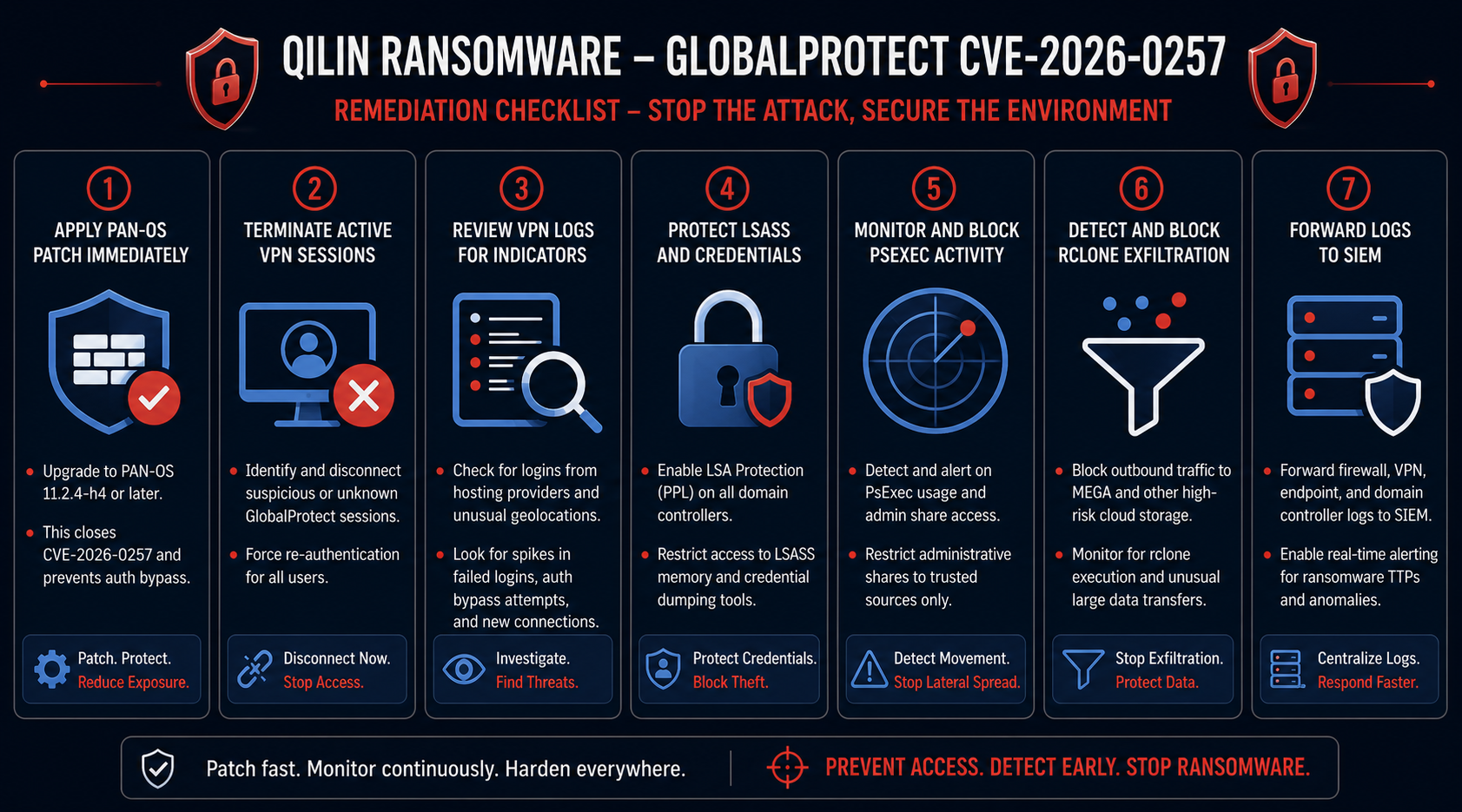
Response should follow a strict priority order.
First, patch affected PAN-OS versions. Second, terminate active GlobalProtect sessions after patching. Third, review VPN logs from the exploitation window. Fourth, hunt for credential theft, lateral movement, and ransomware staging.
Then harden identity, protect LSASS, disable unnecessary authentication override cookies, and forward logs to a remote SIEM.
These steps reduce immediate exposure and improve recovery if compromise already occurred.
Priority One: Patch Affected PAN-OS Versions
Patch every affected PAN-OS GlobalProtect portal and gateway.
Arctic Wolf lists affected branches across PAN-OS 10.2, 11.1, 11.2, 12.1, and certain Prisma Access versions where GlobalProtect and authentication override cookie conditions apply.
Palo Alto Networks’ advisory confirms that Cloud NGFW and Panorama are not impacted by this vulnerability.
Do not delay remediation until the next routine change window if your GlobalProtect environment is exposed and vulnerable.
For broader enterprise vulnerability prioritization, see Digital Warfare’s vulnerability assessment services
Priority Two: Terminate Active GlobalProtect Sessions
Patching blocks new exploitation attempts. It does not automatically remove every session attackers may have created before the patch.
Terminate all active GlobalProtect sessions after patching. Then require full re-authentication.
This step matters because an attacker who already established a VPN connection can continue operating if the session remains valid.
Session termination should be part of the patch playbook for exploited VPN vulnerabilities.
Priority Three: Review VPN Logs From the Exploitation Window
Review GlobalProtect logs from May 17, 2026, through the date you patched and terminated sessions.
Look for suspicious cookie-based authentication, unfamiliar hosting provider IP addresses, unexpected source regions, unusual usernames, administrative login anomalies, and strange endpoint metadata.
Arctic Wolf noted that some observed connections identified themselves as offensive tooling in system metadata.
Correlate VPN logs with firewall logs, endpoint telemetry, identity logs, and SIEM events.
Priority Four: Hunt for LSASS and NTDS Activity
After VPN log review, hunt for credential theft.
Look for LSASS memory access from unusual processes. Monitor for ntdsutil IFM execution and unexpected access to Active Directory database material.
These signals indicate attackers may already have domain credential material.
If confirmed, assume password resets and credential rotation may be necessary. Focus on privileged accounts, service accounts, domain admins, VPN users, and accounts active during the exposure window.
Priority Five: Monitor PsExec, RDP, and Admin Shares
Create detections for PsExec execution, remote service creation, admin share access, and abnormal RDP activity.
These tools often appear legitimate, so context matters. The same behavior becomes high-risk when it follows suspicious VPN access or credential theft.
Monitor PSEXESVC.exe, remote execution across many hosts, file writes to administrative shares, and login activity from unusual accounts.
Lateral movement detection gives defenders a chance to stop the campaign before encryption.
Priority Six: Detect Rclone and Cloud Exfiltration
Monitor Rclone execution and outbound transfers to cloud storage providers, including MEGA.
Focus on unusual data volume, new Rclone binaries, unexpected command-line arguments, and transfers from file servers or systems containing regulated data.
Double extortion changes the response. Teams must consider legal, compliance, privacy, customer notification, and business continuity implications.
Exfiltration detection should run alongside encryption prevention.
Priority Seven: Forward Logs Before Attackers Clear Them
Qilin affiliates cleared Windows event logs before encryption.
That behavior makes remote logging critical. Forward Security, System, Application, PowerShell, Sysmon, VPN, firewall, and identity logs to a remote SIEM in real time.
If attackers clear local logs, the SIEM copy preserves the timeline.
Log clearing should also trigger a high-priority alert, especially if it occurs after suspicious VPN access, PsExec activity, or ransomware staging in C:\PerfLogs.
For related nation-state and network perimeter defense context, see Digital Warfare’s Russian FSB router exploitation analysis
Additional Controls to Reduce Ransomware Impact
Disable authentication override cookies if they are not required.
Use dedicated certificates for authentication override if the feature must remain enabled. Do not reuse certificates across GlobalProtect HTTPS services and cookie encryption paths.
Restrict GlobalProtect access to trusted regions, managed devices, and known IP ranges where business operations allow it.
Enable MFA for privileged accounts and remove default or shared administrative accounts.
Enable Windows Credential Guard and attack surface reduction rules that block credential theft from LSASS.
Maintain tested offline backups and confirm restore speed before an incident.
Broader Security Lessons From the Qilin Campaign
This campaign offers evergreen lessons for enterprise security leaders.
First, perimeter devices need emergency patch priority. VPN appliances, firewalls, and edge gateways are not routine infrastructure. They are high-value entry points.
Second, public proof-of-concept release changes the urgency. Rapid7’s technical analysis appeared on May 29, and exploitation activity expanded immediately afterward.
Third, ransomware affiliates move from access to impact quickly. Once they enter through VPN and harvest credentials, domain-wide encryption can follow fast.
Finally, local logs are not enough. If ransomware affiliates clear event logs before encryption, remote logging becomes the difference between evidence and uncertainty.
Why Proof-of-Concept Release Changes Priority
A vendor patch starts the clock, but a public proof-of-concept accelerates it.
After exploit details become public, more actors can reproduce the attack path. Ransomware affiliates can also test the exploit against exposed devices quickly.
Security teams should treat public exploit release as an emergency trigger.
If the affected asset sits at the perimeter, the response should move even faster.
Why Edge Devices Need Executive Visibility
Edge devices often fall between network operations and security ownership.
That creates delay. One team owns the device. Another team owns vulnerability management. A third team owns detection. Attackers benefit from that gap.
Executives should ask which perimeter devices are internet-facing, who owns their patching, which logs flow to the SIEM, and how quickly sessions can be revoked after emergency updates.
VPN security is now an executive risk issue, not only a network administration task.
Key Takeaway on Qilin Ransomware GlobalProtect VPN Bypass
Qilin ransomware GlobalProtect VPN bypass attacks show how quickly an edge vulnerability can become a domain-wide ransomware event.
CVE-2026-0257 allows unauthorized VPN access when GlobalProtect authentication override cookie conditions are vulnerable. Arctic Wolf connected multiple June 2026 intrusions to this entry point and observed Qilin ransomware deployment.
The defense is priority-driven. Patch PAN-OS, terminate active sessions, review VPN logs, hunt for LSASS and NTDS activity, monitor PsExec and RDP, detect Rclone exfiltration, and forward logs to a remote SIEM.
Organizations that patch but fail to terminate sessions or review logs may still miss compromise that occurred before remediation.
What Organizations Should Do Now
Identify every GlobalProtect portal and gateway.
Confirm whether authentication override cookies are enabled.
Verify the PAN-OS or Prisma Access version against Palo Alto Networks’ fixed releases.
Patch affected systems immediately.
Terminate all active GlobalProtect sessions after patching and force re-authentication.
Review VPN logs from May 17 onward.
Hunt for LSASS dumping, NTDS extraction, PsExec execution, RDP movement, AnyDesk, Ngrok, LogMeIn, Rclone, MEGA transfers, C:\PerfLogs staging, and event log clearing.
Rotate credentials if credential theft appears likely.
Forward Windows and VPN logs to a remote SIEM.
For the one external source in this article, review Arctic Wolf’s research: Cookie Crumbles: How Exploitation of CVE-2026-0257 Leads to Qilin Ransomware
Frequently Asked Questions About Qilin Ransomware GlobalProtect VPN Bypass
What Is the Qilin Ransomware GlobalProtect VPN Bypass?
Qilin ransomware GlobalProtect VPN bypass refers to attacks where Qilin affiliates exploit CVE-2026-0257 in Palo Alto Networks PAN-OS GlobalProtect to establish unauthorized VPN sessions and move toward ransomware deployment.
What Is CVE-2026-0257?
CVE-2026-0257 is an authentication bypass vulnerability in the GlobalProtect portal and gateway components of Palo Alto Networks PAN-OS. It can allow unauthenticated attackers to establish unauthorized VPN connections when specific configuration conditions exist.
Which Conditions Make CVE-2026-0257 Exploitable?
Exploitation requires GlobalProtect portal or gateway exposure, authentication override cookies enabled, and reuse or exposure of the certificate used for authentication override cookies.
How Does Qilin Use the VPN Access?
After gaining VPN access, Qilin affiliates dump LSASS, extract NTDS data, move laterally with PsExec and RDP, deploy remote access tools, exfiltrate data in some cases, stage ransomware in C:\PerfLogs, clear event logs, and encrypt the domain.
What Should Teams Patch First?
Teams should patch affected PAN-OS and Prisma Access versions first. Then they should terminate active GlobalProtect sessions and force re-authentication.
Why Is Session Termination Important After Patching?
Patching blocks new exploitation, but it may not remove VPN sessions attackers established before the patch. Terminating active sessions helps remove unauthorized access that may already exist.
What Indicators Should Defenders Monitor?
Defenders should monitor suspicious GlobalProtect cookie-based logins, VPS source IPs, LSASS access, ntdsutil IFM, PsExec activity, RDP movement, AnyDesk, Ngrok, LogMeIn, Rclone, MEGA transfers, C:\PerfLogs executable staging, and Windows event log clearing.
How Can Organizations Reduce Ransomware Impact?
Organizations can reduce impact by patching quickly, protecting LSASS, forwarding logs to a remote SIEM, monitoring lateral movement, restricting VPN access, disabling unnecessary authentication override cookies, rotating exposed credentials, and maintaining tested offline backups.

