

Introduction
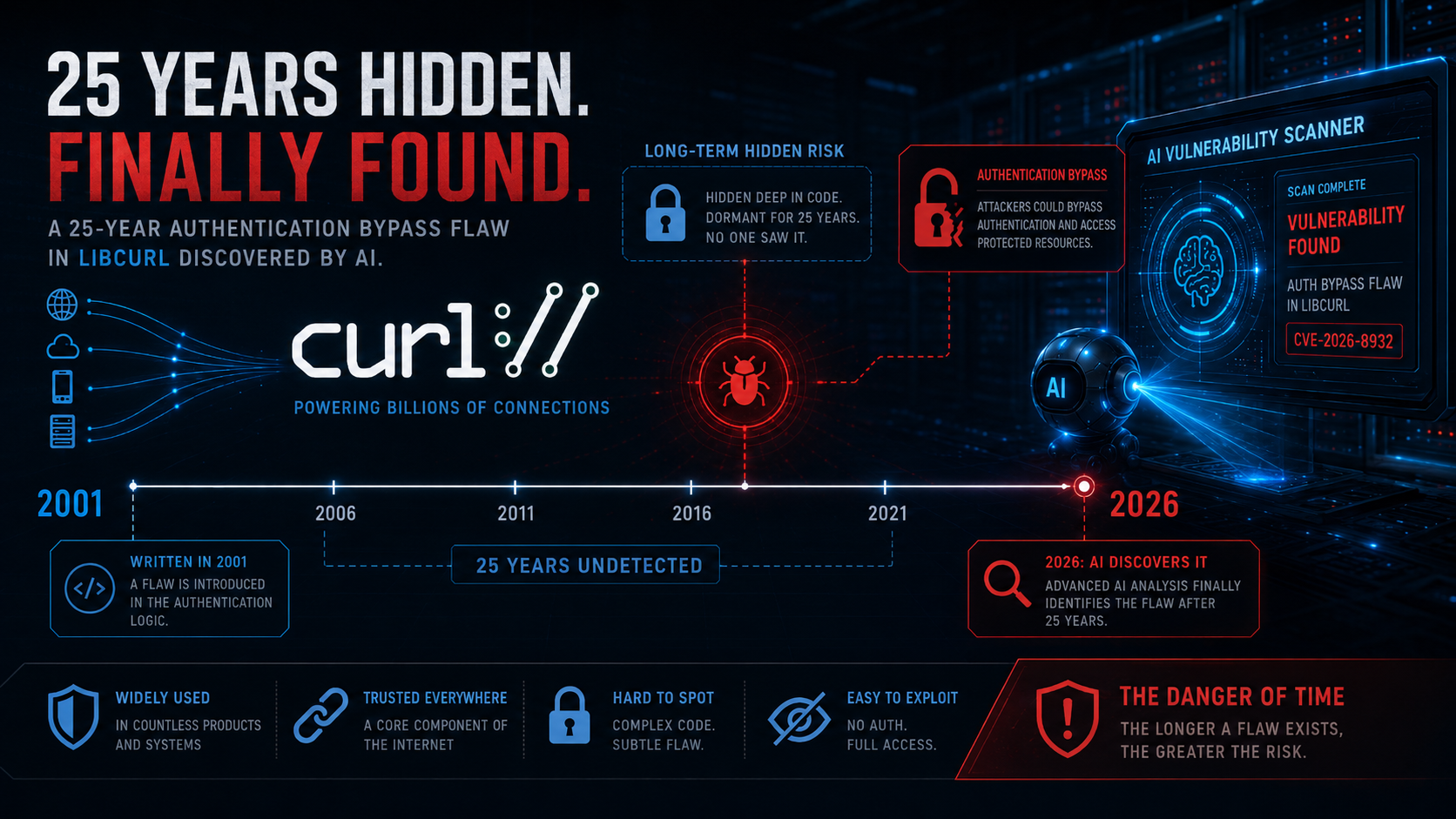
The curl flaw CVE-2026-8932 sat inside one of the world’s most widely used data transfer libraries for more than 25 years. The issue was introduced in curl 7.7, which shipped in March 2001, and remained present through curl 8.20.0. The curl project patched it in curl 8.21.0, released on June 24, 2026.
This vulnerability affects libcurl, the library version of curl used inside applications, platforms, services, and embedded systems. It does not affect the curl command-line tool. That distinction matters because libcurl often runs quietly inside software products where developers, security teams, and end users may not immediately know it is present.
The official curl advisory describes CVE-2026-8932 as incomplete mTLS configuration matching during connection reuse. In practical terms, libcurl could reuse a previously created connection even after certain mutual TLS client certificate options had changed. Under the wrong conditions, that can create an authentication bypass scenario because a connection may be reused when it should have been rejected.
No active exploitation has been confirmed in the official advisory. Still, the age of the flaw, the wide use of libcurl, and the difficulty of finding bundled library copies make this a serious software supply chain remediation task.
Why the curl Flaw CVE-2026-8932 Requires Immediate Action
The right response is to update curl and libcurl to version 8.21.0 or later wherever possible. Organizations that cannot update immediately should apply the upstream patch and rebuild affected software. The curl project also recommends avoiding handle reuse when changing client certificate details if immediate patching is not possible.
The risk is not only the severity rating. The official advisory rates this issue as Low severity, but low severity does not mean low operational effort. Because libcurl is embedded into so many products, finding every vulnerable copy can be harder than applying the fix itself.
This pattern of hidden exposure inside trusted tools mirrors broader supply chain risks discussed in Digital Warfare’s Velociraptor attack analysis, where legitimate tools and trusted components became part of the security risk picture.
What Is the curl Flaw CVE-2026-8932
The curl flaw CVE-2026-8932 is an authentication bypass issue in libcurl’s connection reuse logic. It occurs when libcurl decides whether an existing connection can be reused for a later transfer.
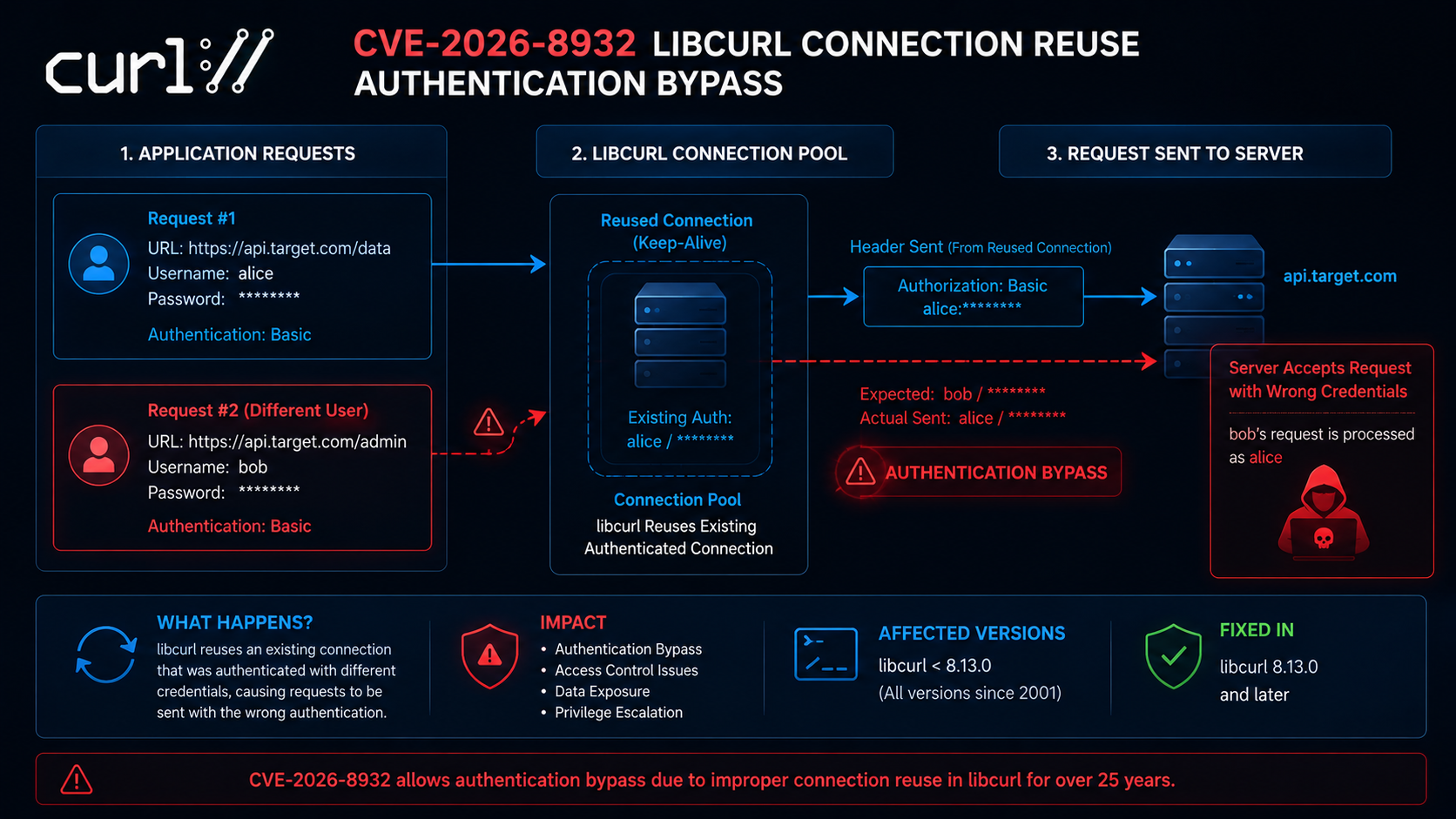
libcurl keeps previously used connections in a pool so later requests can reuse them. This improves performance because applications do not always need to open a fresh connection for every transfer. However, the vulnerable logic failed to include some mTLS-related settings in the comparison that determines whether a connection is safe to reuse.
The specific issue involves mutual TLS configuration, especially options related to client certificates and private keys. If those details changed between transfers, libcurl should have rejected the existing connection and created a new one. Instead, affected versions could match the connection too loosely and reuse it.
Key Facts About the curl Flaw CVE-2026-8932
CVE-2026-8932 affects libcurl versions from 7.7 through 8.20.0. Versions before 7.7 are not affected, and versions 8.21.0 and later contain the fix.
The flaw was published by the curl project on June 24, 2026. It was reported to the curl project on May 13, 2026. The official advisory credits Joshua Rogers of Aisle Research for both reporting and patching the issue.
The weakness is classified as CWE-305, Authentication Bypass by Primary Weakness. The curl project rates the severity as Low. The issue does not affect the curl command-line tool because the vulnerable behavior belongs to libcurl’s library-level connection reuse handling.
Why the curl Flaw Affects So Many Systems
The most important word in this advisory is libcurl. The curl command-line tool is visible and easy to check. libcurl is different. It is a library that many applications compile, package, bundle, or call indirectly.
That means the vulnerable code may exist inside software even when no one runs the curl command directly. It may be present in application frameworks, server components, cloud tooling, embedded firmware, mobile applications, developer tools, and internal services.
Many vendors do not clearly advertise that their product uses libcurl. Some products statically link it. Others ship a private bundled copy. This makes discovery and patch verification difficult. Updating the operating system curl package may not fix every vulnerable libcurl copy inside your environment.
How the curl Flaw CVE-2026-8932 Was Finally Found
The official advisory says the issue was reported to the curl project on May 13, 2026 and fixed in the coordinated curl 8.21.0 release on June 24, 2026. Public reporting credits Aisle Research with finding the issue using AI-assisted security research methods.
This discovery matters because the bug lived in old and trusted code. Connection reuse is a mature feature that developers depend on every day. Bugs in stable code can be difficult to spot because reviewers often focus on newer features, recent changes, or obviously risky parsing logic.
The larger lesson is clear. Old code is not automatically safe code. If a behavior has existed for decades, it may be stable, but it may also contain assumptions that were never tested against modern security expectations.
Timeline of the curl Flaw CVE-2026-8932
The vulnerable behavior dates back to curl 7.7 in March 2001. For more than two decades, the issue remained unnoticed through many releases and reviews.
The issue was reported to the curl project on May 13, 2026. The curl project then coordinated a fix and released curl 8.21.0 on June 24, 2026, alongside a large set of additional security fixes.
The June 24 release was notable because curl published 18 vulnerabilities at once, a project record for a single release. That does not mean all issues carried the same risk, but it does mean security teams should treat curl 8.21.0 as an important update across software supply chains.
How AI Found What Human Auditors Missed
Aisle Research has publicly described its use of AI-assisted methods to identify issues in curl. The important point for defenders is not that AI magically replaced human review. It is that AI-assisted analysis can examine old code paths, state transitions, and edge-case logic that human reviewers may not prioritize.
Connection reuse logic is exactly the kind of place where subtle state mismatches can hide. The code may work correctly in most everyday cases, while still failing under specific combinations of authentication options.
The practical lesson is that mature dependencies deserve renewed review. AI-assisted tooling, software composition analysis, fuzzing, and targeted code review can work together to expose risks that traditional manual review missed.
How the curl Flaw CVE-2026-8932 Works Technically
The vulnerability sits in libcurl’s connection reuse decision logic. When an application makes a request, libcurl checks whether it can reuse an existing connection instead of opening a new one.
For reuse to be safe, libcurl must confirm that the existing connection matches the requirements of the new transfer. That includes the destination, protocol, TLS properties, authentication context, and client certificate configuration.
In affected versions, some mTLS-related settings were not included in that matching logic. As a result, libcurl could treat a connection as reusable even when changed client certificate or private key options should have forced a new connection.
Why the curl Flaw Bypasses Authentication Expectations
The bypass is not a simple “no password needed” flaw. It is more subtle. The risk appears when an application uses libcurl with mutual TLS and changes client certificate-related options between transfers.
If libcurl reuses a connection tied to a previous certificate context, the application may believe it is using one identity while the underlying connection reflects another. That mismatch breaks the security assumption that each request is authenticated according to its current configuration.
In high-trust systems, that type of mismatch can matter. Service-to-service communication, API clients, internal platforms, and security-sensitive automation may depend on exact client certificate behavior.
What This Means in Practice
For many environments, the direct risk may be narrow because the issue requires specific libcurl usage patterns involving mTLS configuration changes and connection reuse. That is why the official severity is Low.
However, organizations should still take it seriously because vulnerable libcurl copies can be hard to find. A single internal service using mTLS with libcurl in the affected way may create an unexpected identity or access-control failure.
The safest approach is to update first, then investigate where libcurl is used for authenticated service-to-service calls, client certificate workflows, API gateways, internal tooling, and software agents.
Other Flaws Fixed in curl 8.21.0
CVE-2026-8932 was not the only issue fixed in curl 8.21.0. The curl project published 18 vulnerabilities in that release, covering a range of severity levels and affected components.
Security teams should not patch only for this CVE. They should treat curl 8.21.0 as a broad security maintenance release. Updating libcurl reduces exposure to multiple issues at once.
This is especially important for container images, internal application builds, CI/CD runners, firmware images, and vendor-supplied packages that may lag behind upstream releases.
Why the curl Flaw CVE-2026-8932 Puts Organizations at Risk
The primary risk is dependency visibility. Organizations often know which operating system packages they install, but they may not know which applications bundle private copies of libcurl.
A server may show an updated curl package while an application still runs an older statically linked libcurl version. A container image may inherit an outdated library from an old base image. An IoT device may carry a vulnerable libcurl version that is difficult or impossible to update without vendor support.
This is why the curl flaw is a software supply chain issue as much as a vulnerability issue.
Who Is Actually Affected by the curl Flaw
Applications that use libcurl and rely on connection reuse while changing mTLS client certificate options are the most directly relevant. Systems that do not use libcurl, do not use mTLS, or do not change client certificate configuration between transfers may not hit the vulnerable path.
However, exposure assessment still matters. Security teams cannot make safe decisions until they know where libcurl exists and how applications use it.
Developers should review applications that perform authenticated API calls, service-to-service communication, certificate-based identity, internal automation, proxying, and connection pooling through libcurl.
Enterprise and Developer Risk
Enterprise environments often depend on libcurl inside internal applications, vendor agents, deployment tools, monitoring platforms, identity workflows, and API clients. Many of these systems communicate with privileged services.
Developers may assume libcurl correctly separates connection state across different credential configurations. That is normally a reasonable expectation, but this flaw shows why security-sensitive client certificate changes need careful testing.
Engineering teams should update libcurl, rebuild affected software, and run integration tests around mTLS workflows. Any application that changes client certificates or private key configuration between transfers deserves special review.
SMB and End User Risk
Small businesses and end users may not directly manage libcurl. They often rely on operating system vendors, application vendors, package maintainers, and device manufacturers to deliver updates.
That makes vendor communication important. If a business uses software that embeds libcurl, the vendor should confirm whether the product is affected and when the fixed version will ship.
Consumer devices, routers, appliances, and embedded systems may be slower to update. Where those devices use mTLS-backed service communication, vendors should review exposure and release firmware updates if necessary.
Supply Chain and Regulatory Risk
Software bill of materials programs are directly relevant to this issue. Organizations that maintain accurate SBOMs can identify where libcurl exists and which versions are present. Organizations without SBOM visibility may need manual scanning, vendor outreach, and build-system review.
A confirmed authentication mismatch involving protected data may have compliance implications, especially in regulated environments. The risk depends on how libcurl is used, what data is transferred, and whether the flaw caused unauthorized access or disclosure.
For broader supply chain context, see Digital Warfare’s Databricks TeamPCP supply chain attack analysis.
Real-World Scenarios for the curl Flaw CVE-2026-8932
A microservice platform could use libcurl to communicate with several internal APIs using different client certificates. If the application changes certificate options across transfers and libcurl reuses a connection incorrectly, the request may be authenticated under an unexpected certificate context.
A CI/CD pipeline could use a libcurl-based tool to reach internal artifact repositories. If different certificate configurations are used across requests, incorrect connection reuse may create confusing authentication behavior that is difficult to detect.
An IoT device may bundle an old libcurl version for telemetry or backend communication. If it uses mTLS to identify itself to different services, the bug could create unexpected identity handling until the firmware is updated.
An enterprise application may update the system curl package but still carry a private libcurl copy inside the application bundle. The organization may believe it has patched while the vulnerable library remains active.
A vendor-supplied agent may use libcurl internally without listing it clearly in product documentation. The customer may need a vendor statement to confirm whether curl 8.21.0 or the upstream patch has been incorporated.
How to Find and Fix the curl Flaw CVE-2026-8932
Start by finding every curl and libcurl instance in your environment. Operating system package updates are only one part of the answer. You must also inspect applications, containers, static builds, embedded software, CI/CD images, developer workstations, and vendor products.
Software composition analysis can help identify direct and transitive libcurl dependencies. Container scanning can identify outdated base images. Build-system review can identify statically linked libraries and vendored code.
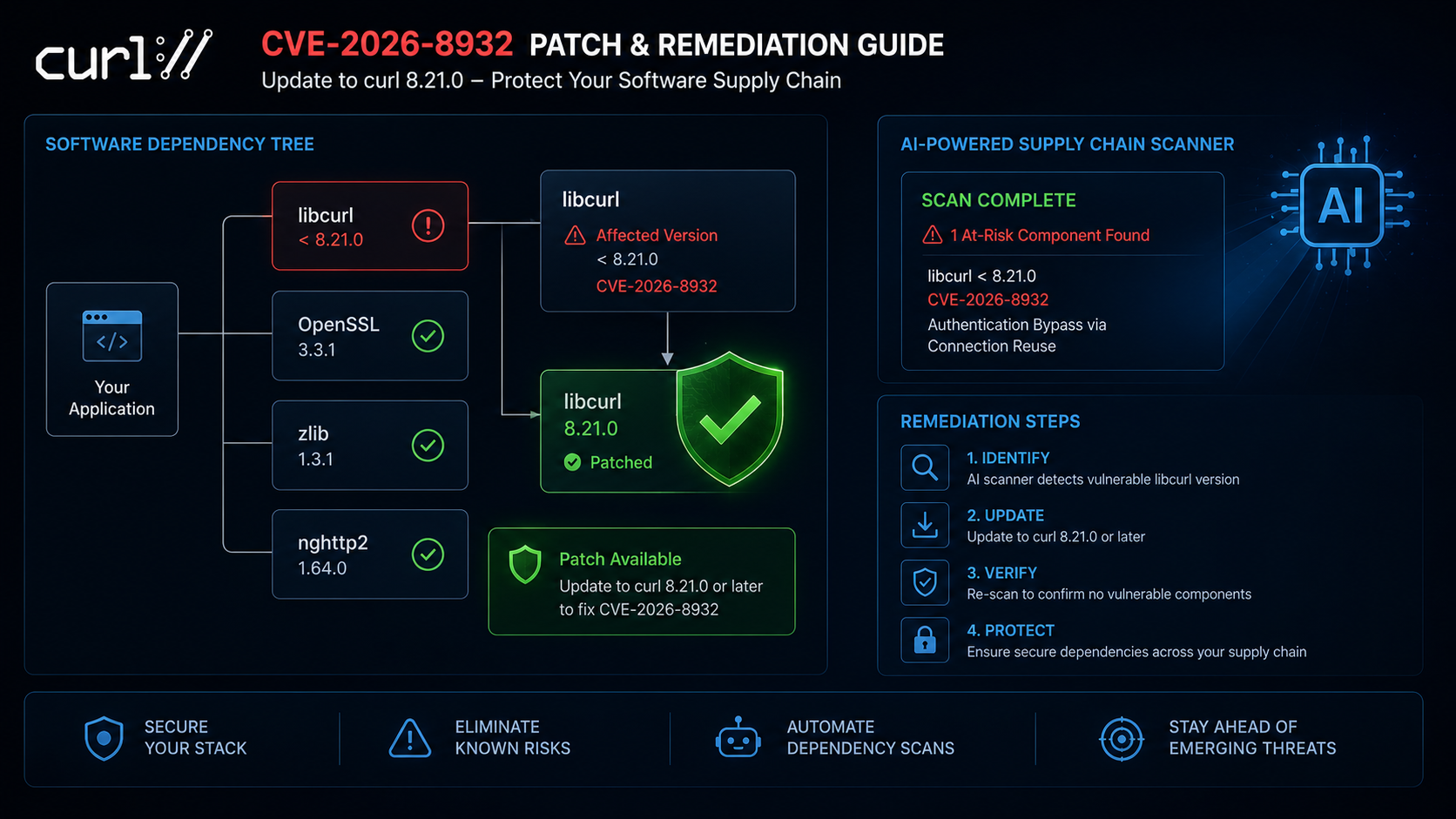
Once identified, update to curl and libcurl 8.21.0 or later. If that is not possible, apply the upstream patch and rebuild. If neither option is immediately available, avoid reusing handles when changing client certificate details.
Find All curl and libcurl Instances
Search your package inventory for curl and libcurl versions below 8.21.0. Then go deeper. Check container images, CI/CD runners, build artifacts, vendor packages, compiled binaries, and embedded firmware.
Review SBOM records if available. If you do not have an SBOM, use this event as a reason to build one. Dependency visibility is now a security requirement, not just a development convenience.
Ask vendors to confirm whether their products bundle libcurl and whether they are affected by CVE-2026-8932. Vendor answers should include the libcurl version and the expected patch timeline.
Update to curl 8.21.0 Everywhere
Update curl and libcurl to 8.21.0 or later on servers, workstations, container images, and application build environments.
Rebuild any application that statically links or privately bundles libcurl. Updating the operating system package alone will not fix a private copy embedded inside an application.
Confirm the runtime version after deployment. Build manifests can be misleading if cached or vendored libraries remain in use.
Review Applications That Use mTLS and Connection Reuse
After patching, review applications that use mutual TLS through libcurl. Focus on code paths that change client certificates, private keys, TLS options, or authentication identities between transfers.
Review use of connection reuse and handle reuse. The official advisory recommends avoiding handle reuse when changing client certificate details if patching is delayed.
Run integration tests against authenticated endpoints to confirm that each request uses the expected identity and certificate configuration.
Threat Detection and Monitoring
Detection will be difficult because the issue may not generate obvious security logs. It is not a loud exploitation pattern. It is a state-management flaw inside connection reuse.
Review recent application logs for unexpected authentication behavior, unusual service identity use, failed mTLS handshakes, unexpected access patterns, or requests reaching services under the wrong identity.
Add monitoring for outbound service-to-service traffic from libcurl-based applications. Unexpected destinations, unusual certificate identities, and authentication anomalies should be investigated.
For the one external source in this article, review the official curl project advisory for CVE-2026-8932.
What the curl Flaw CVE-2026-8932 Tells Us About Security in 2026
This finding goes beyond one curl patch. It shows that old code can still hide security problems, even in mature and heavily used projects.
It also shows why dependency visibility matters. A vulnerability in a library can remain invisible to users if the library is embedded, statically linked, or hidden inside vendor products.
Finally, it shows that AI-assisted research is becoming more useful for mature codebases. Human review remains essential, but AI-assisted methods can help examine edge cases and long-lived logic that human teams may overlook.
Old Code Still Carries New Risk
Security teams often focus on new code, new features, and new dependencies. That makes sense, but it can leave stable code under-reviewed.
CVE-2026-8932 shows that long-lived code can still contain subtle security flaws. The fact that code has worked for years does not prove that every security assumption inside it is correct.
Old dependencies should be part of regular security review, especially when they handle identity, authentication, encryption, connection reuse, or data transfer.
AI Is Now Finding Flaws Humans Missed
AI-assisted research can help uncover bugs in complex state machines, authentication flows, connection reuse logic, and protocol handling. These are areas where subtle combinations of settings matter.
The key is quality. AI-generated findings still need human validation, responsible disclosure, and careful patch development. Low-quality automated reports create noise. Focused AI-assisted research can create real security value.
The curl 8.21.0 release shows how AI-assisted discovery can contribute meaningfully when it is paired with responsible reporting and project collaboration.
Software Bill of Materials Is Now Security Critical
An SBOM helps answer the most important question in this incident: where is libcurl running?
Without that visibility, teams may update the obvious system package and miss private copies hidden inside applications. That creates a false sense of security.
Organizations should maintain dependency inventories for applications, containers, firmware, and vendor-supplied tools. The next library vulnerability will not wait for teams to build visibility from scratch.
Careful Disclosure and AI Research Can Work Together
The official curl advisory shows responsible disclosure in action. The issue was reported, patched, assigned a CVE, and published with mitigation guidance.
That process matters. AI-assisted research becomes valuable when it helps projects fix real vulnerabilities before attackers can take advantage of them.
The goal should not be fast disclosure for attention. The goal should be accurate findings, validated impact, coordinated fixes, and clear guidance for users.
Key Takeaway on the curl Flaw CVE-2026-8932
The curl flaw CVE-2026-8932 is an old libcurl connection reuse bug involving incomplete mTLS configuration matching. It affected curl versions 7.7 through 8.20.0 and was fixed in curl 8.21.0.
The official severity is Low, but the operational lesson is larger. libcurl is embedded across many software stacks, and organizations may not know where vulnerable versions exist.
Update to curl 8.21.0 or later, rebuild applications that bundle libcurl, review mTLS connection reuse behavior, and improve SBOM visibility so future dependency flaws are easier to handle.
What to Do Right Now
Update curl and libcurl to version 8.21.0 or later across servers, workstations, containers, build systems, and development environments.
Run software composition analysis to find every use of libcurl across your codebase, dependency tree, and container fleet.
Rebuild applications that bundle private copies of libcurl below 8.21.0. Confirm the deployed runtime version, not only the build manifest.
Ask vendors to confirm whether their products use libcurl and whether they have incorporated the CVE-2026-8932 fix.
Review applications that use libcurl for mTLS authenticated requests, especially where client certificate details change between transfers.
Add curl and libcurl version monitoring to your vulnerability management workflow.
Build or update your SBOM so future library flaws can be triaged faster.
Also see Digital Warfare’s Splunk Enterprise flaw analysis for more on how deeply embedded infrastructure components can create wide security exposure.
Frequently Asked Questions About the curl Flaw CVE-2026-8932
What Is the curl Flaw CVE-2026-8932?
The curl flaw CVE-2026-8932 is an authentication bypass issue in libcurl involving incomplete mTLS configuration matching during connection reuse. Affected versions could reuse a connection even when client certificate-related settings had changed and should have prevented reuse.
How Long Did CVE-2026-8932 Go Hidden?
The issue was introduced in curl 7.7, which shipped in March 2001, and remained present through curl 8.20.0. It was fixed in curl 8.21.0 on June 24, 2026, meaning the vulnerable behavior existed for more than 25 years.
Is the curl Flaw CVE-2026-8932 Being Actively Exploited?
The official curl advisory does not report confirmed active exploitation. Organizations should still patch promptly because libcurl is widely embedded and vulnerable versions may be difficult to find.
Does CVE-2026-8932 Affect the curl Command-Line Tool?
No. The official curl advisory says the issue does not affect the curl command-line tool. It affects libcurl, the library used by applications that maintain and reuse connections across transfers.
How Does the curl Flaw Work Technically?
libcurl keeps a pool of open connections for reuse. CVE-2026-8932 occurs because some mTLS client certificate-related settings were omitted from the connection matching logic. This could allow libcurl to reuse a connection when a new one should have been created.
How Should Organizations Respond to CVE-2026-8932?
Organizations should upgrade curl and libcurl to 8.21.0 or later, rebuild applications that bundle private libcurl copies, scan software supply chains for affected versions, review mTLS connection reuse behavior, and ask vendors to confirm their patch status.

