
![Critical python.org vulnerability in the release management API allowed attackers to forge admin-level requests]](https://digitalwarfare.com/wp-content/uploads/2026/06/ChatGPT-Image-Jun-26-2026-06_42_45-PM-1024x538.png)
Introduction
A critical python.org vulnerability sat inside the Python release management API for more than a decade before it was patched. The flaw could have allowed attackers to forge administrator-level API requests by supplying a valid admin username with any arbitrary API key.
That matters because python.org is not just a website. It is one of the most trusted software distribution points in the world. Python powers AI platforms, cloud automation, financial systems, healthcare software, government infrastructure, developer workstations, and CI/CD pipelines.
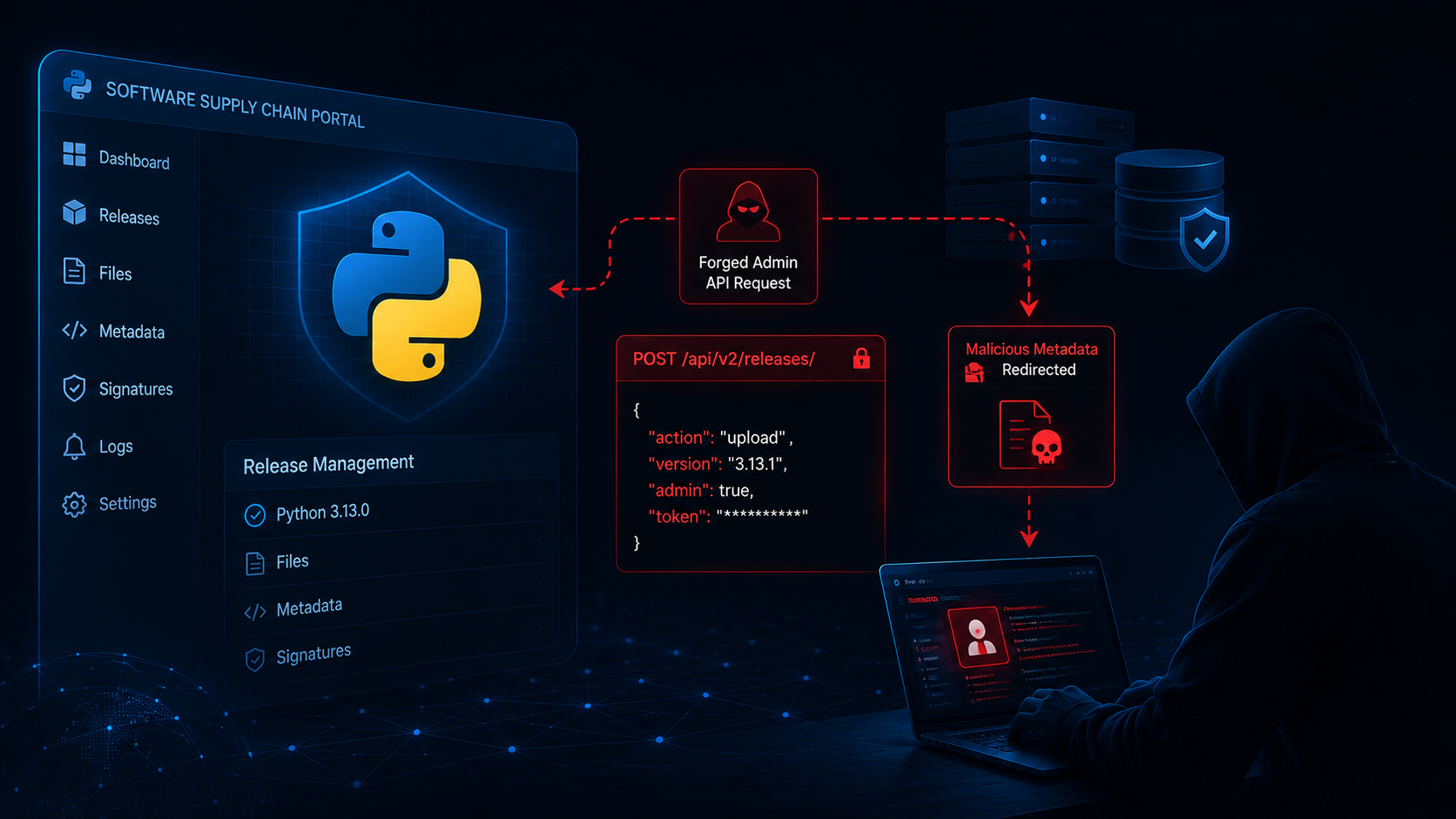
If exploited, the python.org vulnerability could have allowed an attacker to modify Python release and file metadata, including the URLs users see when downloading Python from python.org. It could not directly modify existing release binaries in place, but it could have changed the links pointing users to release files and verification material.
That distinction is important. The attacker would not need to rewrite the original binaries on Python’s infrastructure. If they could redirect users to malicious download URLs and attacker-controlled verification material, they could still create a serious software supply chain attack.
The Python Security Response Team says there is no evidence the python.org vulnerability was exploited. Post-incident review included logs, database backups, Sigstore materials, and PGP verification materials where applicable. Still, the potential impact was severe enough that every security team should understand what happened and what it teaches about supply chain trust.
For related software supply chain context, see Digital Warfare’s analysis of the GitHub data breach and software supply chain risks.
Why the python.org Vulnerability Matters
Python is critical infrastructure for the modern internet. Developers use it to build applications, automate infrastructure, train AI models, run scripts, manage cloud services, and power production systems across nearly every industry.
A compromise of Python’s release metadata could have created a trusted distribution attack. Users visiting python.org/downloads may have been offered malicious download links instead of legitimate ones. Even worse, verification material URLs could also have been modified, weakening the trust model users rely on to confirm file integrity.
Sigstore and PGP verification are designed to protect users from tampered software. However, if an attacker controls both the download URL and the verification URL, users may be tricked into trusting malicious files that appear to validate correctly.
The official Python response confirms that existing release files were not directly editable through this python.org vulnerability. But the ability to alter release metadata and verification URLs would still have created a dangerous path for supply chain compromise.
What Happened in the python.org Vulnerability
The python.org vulnerability was responsibly disclosed on February 23, 2026, by Splitline Ng of the DEVCORE Research Team. The Python Security Response Team confirmed the issue and patched it quickly.
The flaw existed in python.org’s release management API. An attacker could supply a valid admin username with an arbitrary API key, and the request would be processed with administrator privileges.
In simple terms, the system checked whether the username was valid, but it failed to confirm whether the supplied API key belonged to that username. That broke the core security model. An identity claim and the proof of that identity must always be validated together.
The issue had existed in the codebase since 2014. That means the vulnerable logic was present for more than twelve years before discovery.
How the python.org Vulnerability Worked Technically
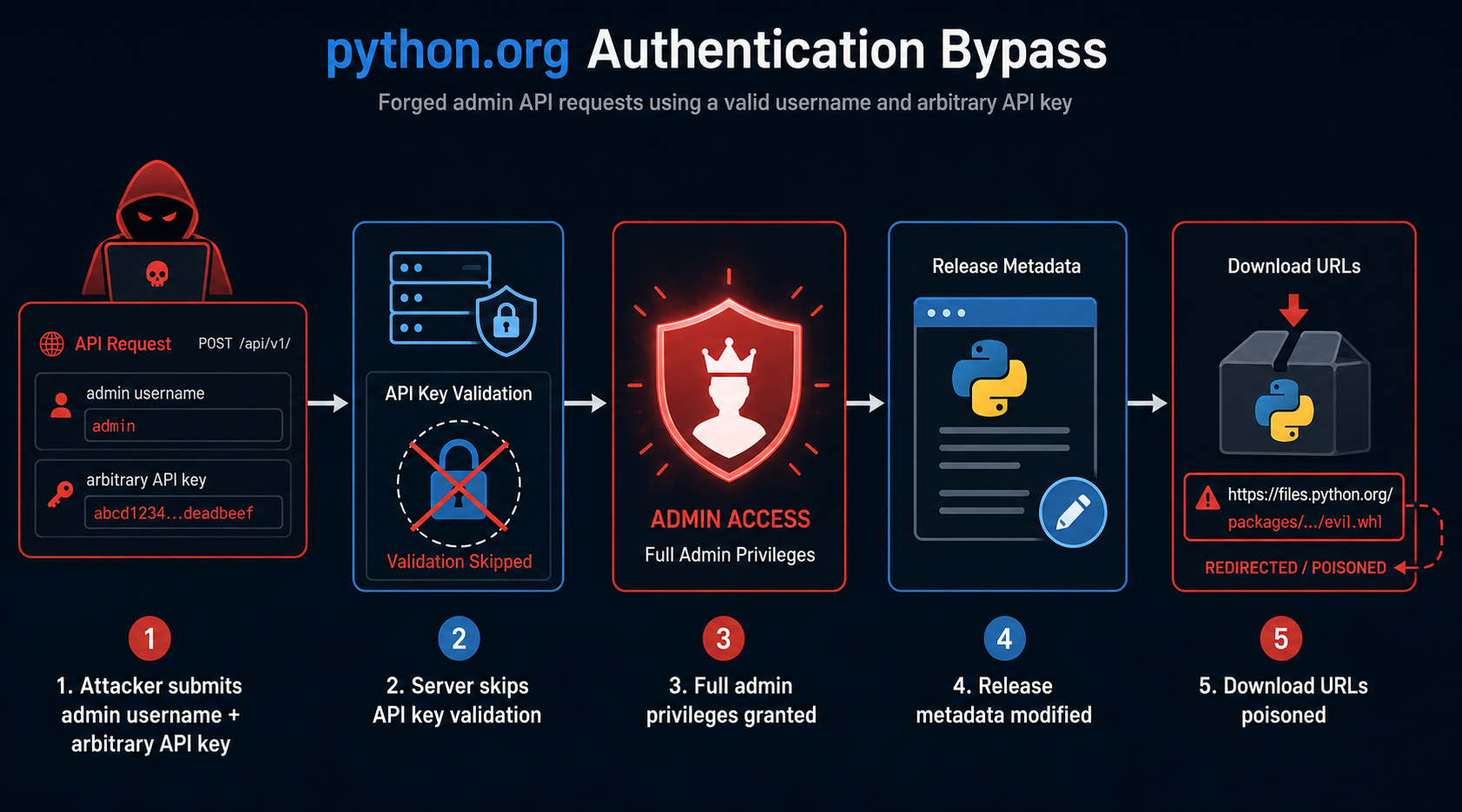
Modern API authentication requires two checks. The system must verify the identity being claimed, and it must verify the credential proving that identity. A username alone is not proof. An API key alone is not enough unless it is tied to the correct user.
The python.org release management API failed at this pairing step. It accepted a valid administrator username but did not properly confirm that the submitted API key matched that administrator.
This created an authentication bypass. It was not a case of weak passwords, credential guessing, or brute force. The request was treated as administrative because the API logic did not validate the credential relationship correctly.
That type of bug is especially dangerous because it can look simple in hindsight while remaining hidden for years in production code.
What Attackers Could Have Done With the python.org Vulnerability
With administrator-level API access, an attacker could have modified Python release and file metadata. The most serious risk involved the URLs users are offered when downloading Python from python.org.
An attacker could potentially change download URLs for Python releases listed on python.org/downloads. They could also modify URLs pointing to Sigstore signature bundles or PGP verification material.
This would create a dangerous trust problem. A user could visit the real python.org website, click a download link, and still be redirected to attacker-controlled infrastructure if the metadata had been tampered with.
The official disclosure makes clear that attackers could not directly modify existing release files in place. However, changing the URLs presented to users could still support a large-scale supply chain attack.
For broader developer ecosystem risk, see Digital Warfare’s analysis of the Databricks TeamPCP supply chain attack.
Why Sigstore and PGP URL Control Is Critical
Sigstore and PGP signatures protect users by allowing them to verify that a downloaded file matches what the trusted project released. These verification systems are essential for open source software distribution.
However, verification only works if users receive the correct verification material from a trusted source. If an attacker can alter the links to both the binary and the verification material, they may be able to create a malicious package and provide matching attacker-controlled verification data.
That does not mean Sigstore or PGP failed. It means the infrastructure publishing the verification pointers must be protected as carefully as the artifacts themselves.
Software supply chain security depends on the full trust chain. The binary, the signature, the signing material, the metadata, and the publishing system all matter.
python.org Vulnerability Timeline: From Introduction to Remediation
The vulnerable logic was introduced into the python.org codebase in 2014. It remained present for more than twelve years.
On February 23, 2026, Splitline Ng of DEVCORE reported the issue to the Python Security Response Team. The same day, PSRT acknowledged and confirmed the vulnerability.
On February 24, 2026, the patch was reviewed and applied to production. DEVCORE then confirmed that the proof of concept no longer worked.
On February 25, 2026, PSRT completed an audit of logs, database backups, Sigstore materials, and PGP materials. The review showed no evidence of exploitation.
On April 23, 2026, LLM-assisted security auditing tools were applied to the codebase and found no additional authentication or authorization issues.
On June 1, 2026, Trail of Bits began a third-party audit of python.org and the Python release process. On June 23, 2026, the final public report was published.
Enterprise Impact of the python.org Vulnerability
For enterprises running Python in production, this python.org vulnerability represents a major software supply chain risk that should be documented in internal risk reviews.
Even though no exploitation was found, the scenario is serious enough to justify review of Python download workflows, artifact verification practices, developer workstation controls, and CI/CD dependency sourcing.
The risk is not limited to Python itself. This incident shows how trusted metadata systems can become attack paths. Any enterprise relying on open source software should review how it validates release artifacts and how it protects build pipelines from poisoned upstream sources.
Developer Workstation Exposure
Developer workstations would have been a likely first target if the python.org vulnerability had been exploited. Developers regularly download Python installers, update runtime versions, test new releases, and install tooling from trusted sources.
If a malicious download URL had been published through python.org metadata, a developer could have downloaded a compromised interpreter while believing it came from the legitimate source.
A compromised developer machine can expose source code, SSH keys, cloud credentials, GitHub tokens, API keys, and CI/CD access. That makes developer systems high-value targets in software supply chain attacks.
CI/CD Pipeline Exposure
Automated build systems often pull runtimes, dependencies, and tools from trusted upstream sources. If a pipeline downloaded Python from a poisoned URL, every artifact built from that environment could become suspect.
CI/CD compromise is especially dangerous because it can scale quickly. A single malicious runtime introduced into a build environment may affect internal tools, production applications, containers, packages, and downstream deployment pipelines.
Security teams should review whether their build systems download Python directly from python.org, from mirrors, from package managers, or from internally validated repositories.
Downstream Distributor Exposure
Linux distributions, cloud providers, container image maintainers, and packaging ecosystems all rely on upstream release metadata and verification workflows. A compromise of trusted metadata could have created confusion across downstream distribution channels.
The Python team noted that many redistributors automatically verify Sigstore and PGP materials, making unnoticed exploitation less likely. That is a strong control, but it also shows why verification infrastructure must remain protected.
If metadata and verification material are both altered, downstream security controls may become less effective unless they use independent trust anchors or separate verification paths.
Compliance and Audit Implications
Organizations with obligations under SOC 2, ISO 27001, FedRAMP, HIPAA, PCI DSS, or internal software assurance programs should document awareness of this disclosure.
Because PSRT found no evidence of exploitation, most organizations do not need to treat this as a confirmed compromise. However, supply chain risk programs should capture the incident as an example of upstream metadata exposure and review their controls accordingly.
Relevant controls include artifact verification, internal mirrors, build provenance, SBOM management, developer endpoint protection, and vendor dependency review.
Real-World Scenarios for the python.org Vulnerability
A targeted developer attack could have focused on a specific enterprise known to use a particular Python version. The attacker could modify metadata for that release, point the download URL to attacker-controlled infrastructure, and replace verification material pointers. The next rebuild or workstation setup could pull a malicious interpreter.
A mass supply chain event could have targeted the most widely used Python release. If the attack remained unnoticed for even a short period, users around the world may have downloaded a tampered runtime from what appeared to be a legitimate python.org workflow.
An AI infrastructure attack could have targeted Python-heavy machine learning environments. Python dominates AI and data science workflows. A compromised Python interpreter in GPU training clusters could expose model weights, training data, proprietary research, and cloud credentials.
These scenarios are hypothetical. The Python Security Response Team found no evidence that this python.org vulnerability was exploited.
How Python Remediated the python.org Vulnerability
The Python Security Response Team responded quickly. The vulnerability was reported and confirmed on February 23, 2026. The patch was reviewed and applied to production on February 24, 2026.
Less than 48 hours after the initial report, PSRT and DEVCORE confirmed that the proof of concept no longer worked locally or on the production deployment.
This is a strong example of coordinated vulnerability disclosure working as intended. The researcher reported privately that the project confirmed the issue, the patch was deployed quickly, and users were protected before public disclosure.
URL Validation Added After the python.org Vulnerability
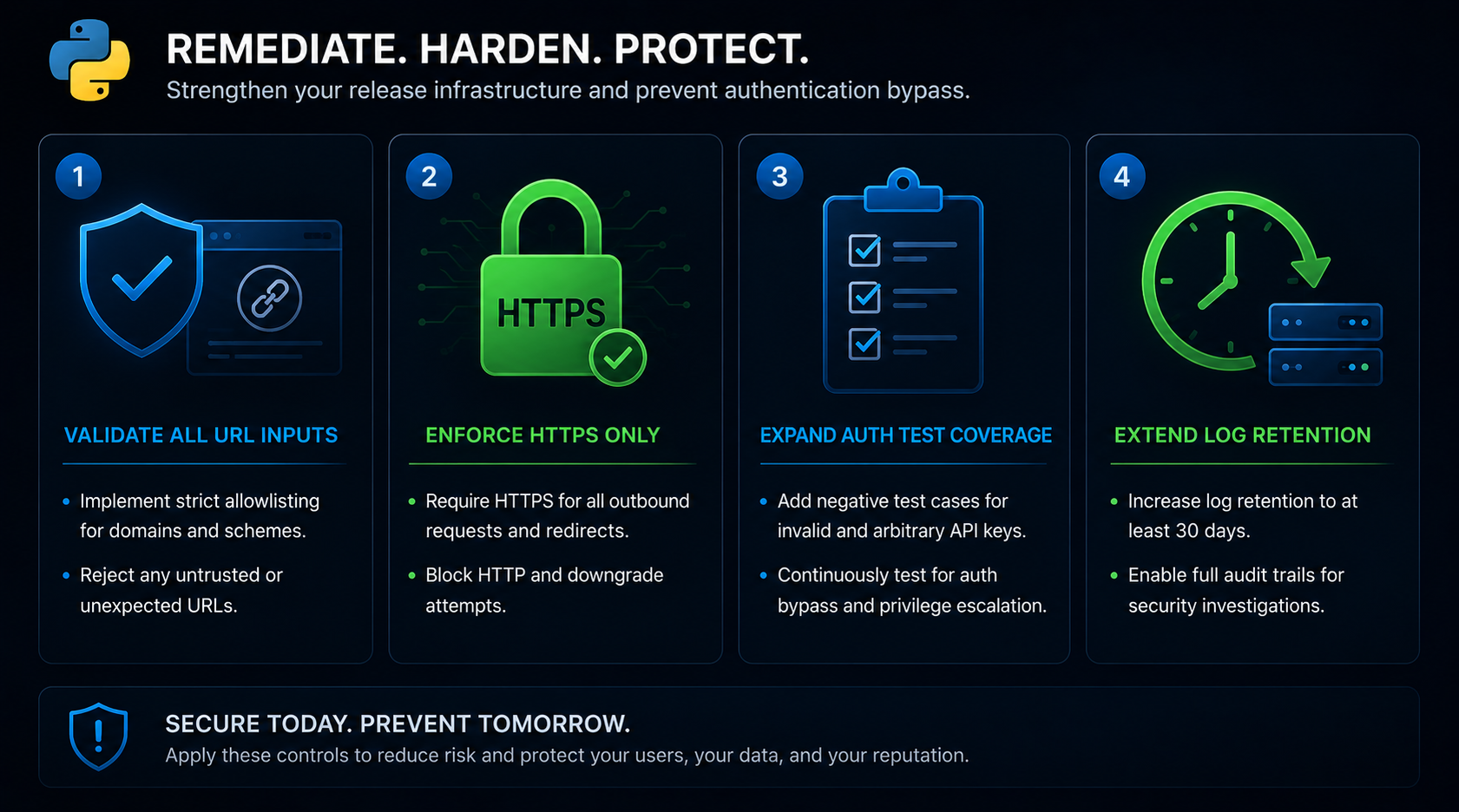
The Python team added a defense-in-depth control requiring database and API URLs to start with https://www.python.org/.
This matters because even if a future authentication or authorization issue were discovered, attacker-controlled external URLs would be rejected by the system.
That additional validation reduces the chance that a metadata flaw could become a download redirection attack. It is a practical control that directly addresses the worst-case scenario.
HTTPS Enforcement and Secure Release URLs
Trail of Bits also improved URL validation by requiring HTTPS URLs for newer releases through a custom field validator.
This reduces the risk of downgrade paths where a URL could point users toward an unencrypted endpoint. HTTPS enforcement is a baseline control for software distribution infrastructure.
For release systems, secure transport is not optional. Users must be protected against tampering, redirection, and man-in-the-middle risk.
Negative Authentication Test Cases
The Python team added test cases for all negative authentication branches. This is an important process improvement.
Authentication systems are often tested for successful login paths, but failure paths can be under-tested. Attackers frequently exploit exactly those edge cases: missing keys, mismatched credentials, partial credentials, malformed tokens, or fallback behavior.
Negative authentication testing helps prevent the same class of bug from returning later.
Extended Log Retention After the python.org Vulnerability
Python increased logging retention for requests to python.org from 3 days to 30 days. That improvement matters for future incident response.
Three days of logs is often too short for meaningful security investigation. Many vulnerabilities are discovered weeks or months after suspicious activity may have occurred.
Longer retention improves the ability to investigate future reports, validate exploitation claims, and build confidence after remediation.
Third-Party Audit After the python.org Vulnerability
The codebase was manually audited, LLM-assisted audit tools were applied, and Trail of Bits conducted a third-party audit of python.org and the Python release process.
The Trail of Bits work was funded by OpenAI, reflecting how important Python infrastructure is to modern AI and software ecosystems.
Independent audits provide confidence that the fix addressed the immediate issue and that no similar authentication or authorization weaknesses were found during the review.
For related support around secure software review, see Digital Warfare’s code review services.
For the one external reference in this article, review the official Python disclosure: Mitigated API authentication bypass for python.org download metadata.
Post-Incident Forensics Confirmed No Exploitation
One of the most important outcomes is the forensic conclusion. The Python Security Response Team found no evidence of exploitation after auditing logs and database backups.
The team also confirmed that artifacts on python.org had not been modified by verifying Sigstore and PGP materials. Sigstore verification did not signal artifact changes from prior years. PGP materials were verified where keys were still available for Python 2.5 through Python 3.13.
Python 3.14 and later no longer provide PGP materials under PEP 761, so those releases were verified with Sigstore.
This means enterprises do not need to reinstall Python based on this specific disclosure. There is no evidence that historical Python downloads were tampered with through this vulnerability.
Broader Security Lessons From the python.org Vulnerability
This vulnerability teaches lessons that apply far beyond Python. Authentication logic must validate every required component together. A valid username is not enough. A valid token is not enough unless it is tied to the correct identity.
Supply chain trust also depends on metadata integrity. Binaries matter, but so do download links, signatures, verification URLs, release pages, package indexes, and publishing APIs.
The incident also shows why defense in depth matters. The authentication fix closed the immediate flaw. URL validation, HTTPS enforcement, negative tests, extended logs, and third-party audit reduced the chance of future recurrence.
Authentication Must Validate Identity and Proof Together
The core issue was a failure to bind the admin username to the API key. The API accepted the identity claim without properly validating the proof.
This is a classic security failure. Authentication systems must verify that the submitted credential belongs to the claimed identity and that the requested action is authorized.
Security reviews should specifically test mismatched credential pairs, arbitrary tokens, missing keys, fallback modes, and guest-to-admin transitions.
Verification Infrastructure Is Part of the Supply Chain
Software supply chain security is not only about protecting release binaries. It is also about protecting the infrastructure that tells users what to download and how to verify it.
If attackers can modify metadata, they can influence trust decisions. If they can alter verification URLs, they can weaken the integrity process.
This is why release management APIs, package indexes, signing systems, build pipelines, and publishing dashboards all need strong authentication, monitoring, and audit trails.
Responsible Disclosure Protected the Ecosystem
DEVCORE privately disclosed the vulnerability. Python’s security team confirmed it, patched it, and performed a deeper audit before publishing the final report.
That process protected users. Public disclosure before remediation could have created unnecessary risk for millions of Python users and downstream distributors.
Responsible disclosure remains one of the most effective ways to protect open source ecosystems when critical infrastructure flaws are discovered.
Log Retention Is a Security Control
The move from 3 days to 30 days of log retention is more than an operational improvement. It is a security control.
Incident response depends on evidence. Without logs, teams cannot confidently answer whether exploitation occurred, what changed, and whether users were affected.
Critical software infrastructure should treat log retention as part of its security baseline, not just a storage setting.
Open Source Security Audits Need Funding
The Trail of Bits audit, funded by OpenAI, is a strong example of the kind of support critical open source infrastructure needs.
Python supports a global technology economy. It underpins AI, cloud platforms, education, research, enterprise software, automation, and government systems.
Projects with that level of dependency need sustained external security investment. Audits, maintainers, security developers, infrastructure hardening, and incident response all require funding.
Key Takeaway on the python.org Vulnerability
The python.org vulnerability was a serious authentication bypass in the Python release management API. It allowed admin-level requests when an attacker supplied a valid admin username with an arbitrary API key.
If exploited, the flaw could have allowed attackers to modify release metadata, including download URLs and verification material URLs. That could have supported a major software supply chain attack.
The Python Security Response Team patched the issue quickly, added additional hardening, extended log retention, and completed forensic review. No evidence of exploitation was found.
The broader lesson is clear. Software supply chain security depends on the integrity of the systems that publish, describe, sign, verify, and distribute software.
What Organizations Should Do Now
Organizations should document this disclosure in their software supply chain risk register. Because Python found no evidence of exploitation, emergency reinstallations are not required based on this specific incident.
Security teams should still review how Python is obtained across developer workstations, CI/CD pipelines, containers, build systems, and production environments.
Where possible, organizations should rely on trusted package sources, internal mirrors, artifact verification, SBOM records, and build provenance controls.
Developers and DevOps teams should verify that automated workflows do not blindly trust metadata from external sources without independent validation.
Security leaders should use this incident to review release integrity controls across all critical dependencies, not only Python.
For broader validation of exposed applications and APIs, see Digital Warfare’s vulnerability assessment services.
Frequently Asked Questions About the python.org Vulnerability
What Was the python.org Vulnerability?
The python.org vulnerability was an authentication bypass in the Python release management API. An attacker could submit a valid administrator username with an arbitrary API key, and the request would be processed with admin privileges.
How Did the python.org Vulnerability Work?
The API validated that the submitted username existed but failed to confirm that the supplied API key belonged to that user. This allowed a forged request to be treated as administrator-level access.
How Long Did the python.org Vulnerability Exist?
The vulnerable code had existed since 2014 and was discovered in February 2026. That means the issue remained present for more than twelve years.
Was the python.org Vulnerability Exploited?
The Python Security Response Team found no evidence of exploitation after auditing logs, database backups, Sigstore materials, and PGP materials where applicable.
Could Attackers Modify Python Binaries Directly?
No. The official disclosure says attackers could not modify existing release files in place. However, they could potentially modify release metadata, including download URLs and verification material URLs.
Do Organizations Need to Reinstall Python?
No. Based on the official forensic findings, there is no evidence that Python artifacts were tampered with through this vulnerability. Organizations do not need to reinstall Python because of this specific disclosure.
Who Reported the python.org Vulnerability?
Splitline Ng of the DEVCORE Research Team responsibly reported the vulnerability to the Python Security Response Team on February 23, 2026.
What Fixes Did Python Add After the python.org Vulnerability?
Python patched the authentication logic, added negative authentication test cases, restricted release URLs to https://www.python.org/, required HTTPS URLs for newer releases, extended log retention from 3 days to 30 days, and completed additional audit work.
Why Is the python.org Vulnerability a Software Supply Chain Issue?
The issue affected release metadata and verification material URLs. If exploited, attackers could have redirected users to malicious downloads while weakening the verification process. That makes it a software supply chain infrastructure risk.

