

Introduction
The Cisco Unified CM flaw CVE-2026-20230 is now being exploited in attacks, and organisations running Cisco Unified Communications Manager need to act immediately. Cisco patched the flaw on June 3, 2026, but public proof-of-concept exploit code and later exploitation activity turned this from a patching issue into an active security risk.
The vulnerability affects Cisco Unified Communications Manager and Cisco Unified Communications Manager Session Management Edition when the Cisco WebDialer Web Service is enabled. Cisco describes the issue as a server-side request forgery vulnerability caused by improper input validation in specific HTTP requests. A successful exploit can allow an unauthenticated remote attacker to write files to the underlying operating system, which can later be used to elevate privileges to root.
That root access risk is why Cisco assigned the advisory a Critical Security Impact Rating even though the CVSS base score is 8.6. For enterprise teams, the practical concern is simple. Cisco Unified CM is not just a phone system. It supports voice, video, call routing, collaboration workflows, device registration, and internal communications across many enterprise environments. A compromised Unified CM node can become a powerful foothold inside the network.
This active attack pattern mirrors the urgency we saw with the Splunk Enterprise flaw, where attackers moved quickly after public disclosure and security teams had to treat the platform as high-risk infrastructure. For related context, see Digital Warfare’s analysis of the Splunk Enterprise vulnerability CVE-2026-20253.
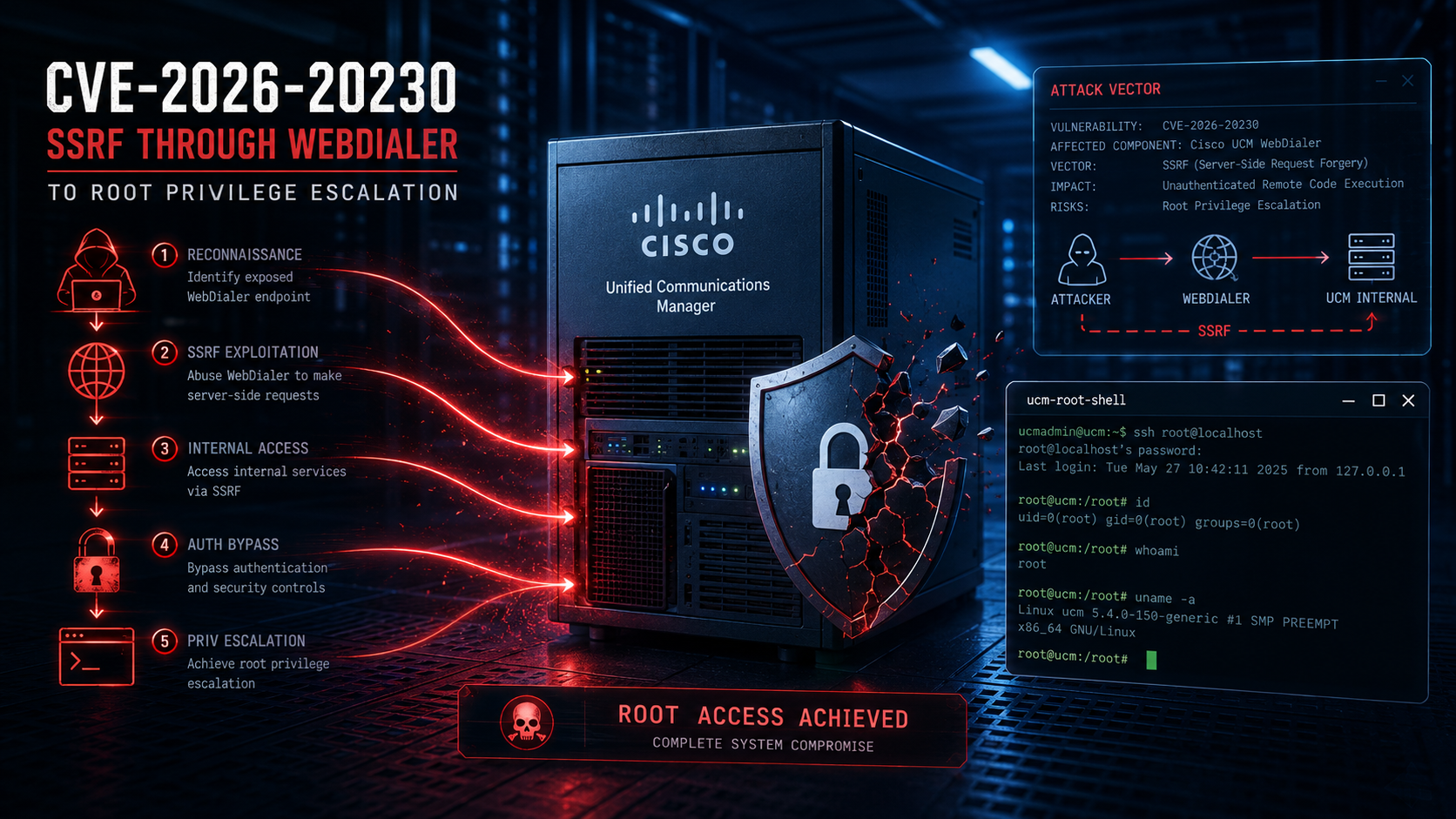
Why the Cisco Unified CM Flaw Demands Immediate Action
The Cisco Unified CM flaw demands immediate action because exploitation requires no authentication. An attacker who can reach the vulnerable WebDialer service can send crafted HTTP requests without needing a username, password, VPN session, or valid administrator account.
The attack is also dangerous because it can move beyond basic SSRF. Cisco’s advisory states that successful exploitation can allow file writes to the underlying operating system. Those file writes can later support root privilege escalation, which means the attacker may gain full control of the Unified CM host.
Organisations should patch immediately or disable WebDialer if patching cannot happen right away. Cisco states there are no full workarounds that fix the flaw itself. Disabling WebDialer removes the attack surface if the feature is not required, but patching remains the full corrective action.
What Is the Cisco Unified CM Flaw CVE-2026-20230
The Cisco Unified CM flaw CVE-2026-20230 is a server-side request forgery vulnerability in Cisco Unified Communications Manager and Cisco Unified CM Session Management Edition. The vulnerable component is the Cisco WebDialer Web Service.
WebDialer is a click-to-dial feature used in some enterprise communications deployments. The flaw exists because the service does not properly validate specific HTTP request input. This allows an attacker to craft a request that causes the affected system to process attacker-controlled input in an unsafe way.
In the worst case, the attacker can use this behavior to write files to the underlying operating system. Once an attacker can write files to sensitive locations, the path to root-level compromise becomes much more realistic.
Key Facts About the Cisco Unified CM Flaw
CVE-2026-20230 affects Cisco Unified CM and Cisco Unified CM SME deployments where the Cisco WebDialer Web Service is enabled. Cisco says WebDialer is disabled by default, which means exposure depends on whether the service was enabled in a specific environment.
Cisco assigns the vulnerability a CVSS 3.1 base score of 8.6. However, Cisco gives the advisory a Critical Security Impact Rating because successful exploitation can allow file writes that may later support root privilege escalation.
Cisco published the advisory on June 3, 2026. Fixed releases are available, including Cisco Unified CM 14SU6. For some Release 15 environments, Cisco made an interim COP patch available while full fixed releases were planned.
Why Cisco Rated the Flaw Critical Despite an 8.6 Score
The CVSS score alone does not fully communicate the operational risk. A score of 8.6 normally falls into the High range, but Cisco elevated the advisory to Critical because of the realistic end state of the attack.
The issue is not merely that an attacker can force a server-side request. The concern is that the attacker can use the flaw to write files to the operating system. Those files can later be used to gain root privileges.
Root access on a Unified CM node is a serious outcome. It can allow tampering with platform configuration, service behavior, logs, integrations, call-control functions, and adjacent access paths. That is why the flaw should be treated as emergency-level even if the numeric CVSS score does not reach 9.0.
How and When the Cisco Unified CM Flaw Was Discovered
Cisco published the advisory and security updates on June 3, 2026. At the time of initial disclosure, Cisco said it was not aware of malicious exploitation. However, proof-of-concept code became public, and later reporting confirmed active exploitation attempts.
The timeline matters because it shows how quickly enterprise infrastructure flaws become operational threats. A flaw disclosed with public exploit material can move from patch notice to attacker scanning in days or weeks.
Security teams should not wait for widespread compromise before acting. If Unified CM is reachable and WebDialer is enabled, the system should be patched or the service should be disabled immediately.
How Attackers Exploit the Cisco Unified CM Flaw Step by Step
The attack begins with target discovery. Attackers scan for Cisco Unified CM or Unified CM SME systems where WebDialer is reachable. If WebDialer is disabled, the specific attack surface is not present. If it is enabled, the system may be exposed.
The attacker then sends a crafted HTTP request to the WebDialer endpoint. Because the attack does not require authentication, the attacker only needs network reachability to the vulnerable service.
The crafted request triggers SSRF behavior. The affected Unified CM system processes attacker-controlled input in a way that can cause unsafe internal behavior.
The attacker can then attempt file write operations against the underlying operating system. Public reporting has described scanning activity using test file writes to confirm exposure. The same general file-write path can become more dangerous if attackers attempt to place scripts, web shells, or modified files in sensitive locations.
Finally, the written files may be used to elevate privileges to root. At that stage, the attacker may gain full control of the Unified CM node.
Why the Cisco Unified CM Flaw Exists
The flaw exists because the WebDialer service fails to properly validate specific HTTP request input. Server-side request forgery vulnerabilities happen when an attacker can influence how a server makes or processes requests.
SSRF is especially dangerous in enterprise platforms because the affected system often has access to internal resources that an outside attacker cannot normally reach. When the trusted server performs unsafe actions on the attacker’s behalf, the attacker can cross boundaries that were supposed to protect the environment.
In this case, the SSRF behavior can support file writes to the operating system, which creates the root escalation path.
What Attackers Do With Root on a Unified CM Node
Root access on a Cisco Unified CM node gives an attacker deep control over a critical communications platform. They may tamper with call routing, alter configuration files, create persistence, disrupt communication services, or use the system as a pivot point into adjacent internal networks.
Attackers may also search for credentials, tokens, integration settings, backups, service accounts, and internal connectivity from the Unified CM host. Because Unified CM often sits in a trusted enterprise communications segment, it may have access to systems and services that ordinary endpoints cannot reach.
A root-level Unified CM compromise should therefore be treated as a broader enterprise incident, not just a voice-platform issue.
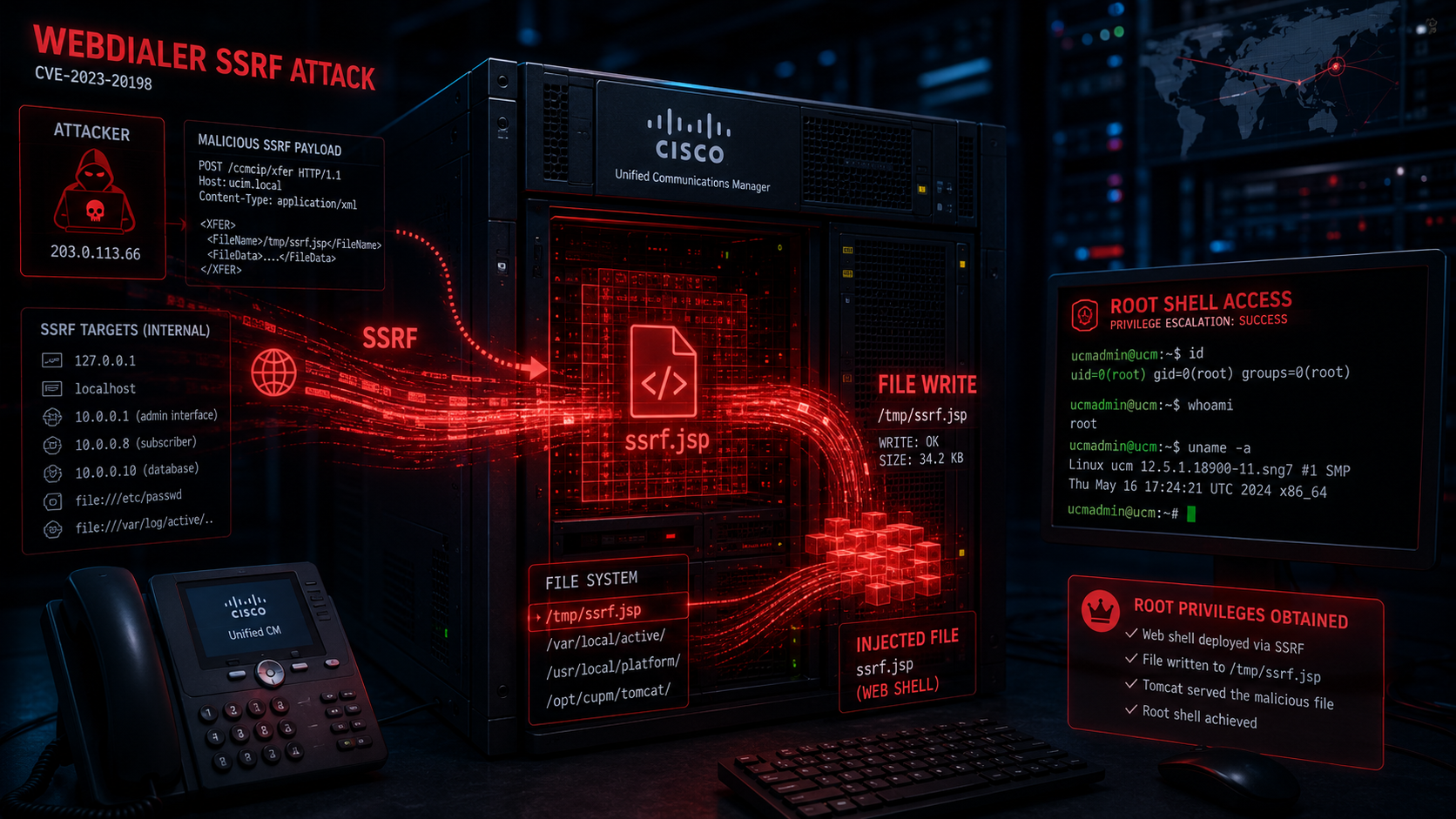
Why the Cisco Unified CM Flaw Puts Every Enterprise at Risk
The Cisco Unified CM flaw affects enterprise environments because Unified CM is often deeply embedded in voice, video, collaboration, and device-management workflows. It is easy for security teams to under-prioritize communications infrastructure because it may not look like a traditional application server or database.
That is a mistake. Communications systems carry sensitive metadata, service dependencies, integration settings, and internal trust relationships. A compromised Unified CM node can affect business continuity, incident response coordination, executive communications, and operational resilience.
The biggest risk is not only downtime. The bigger risk is a trusted internal platform becoming an attacker-controlled pivot point.
Enterprise Impact of the Cisco Unified CM Flaw
In large environments, Cisco Unified CM can support thousands of users, endpoints, phones, soft clients, contact center workflows, voicemail integrations, and collaboration services. If a core node is compromised, disruption can spread across the business quickly.
Root access may allow attackers to alter how the system operates. They could attempt to interfere with call routing, manipulate logs, modify configuration, or install persistent access.
Enterprise teams should also consider whether Unified CM nodes have access to directory services, monitoring systems, backup systems, management networks, or cloud-connected services. Those connections can expand the blast radius beyond the communications platform.
SMB and Mid-Market Risk
Smaller and mid-market organisations may face a different risk profile. They may not have a large security operations team monitoring Unified CM logs, service status, and file-system changes. They may also have enabled WebDialer years ago for a specific project and forgotten it remained active.
For these organisations, the first step is simple. Check whether WebDialer is running. If it is not needed, disable it. Then patch the system as soon as possible and review logs for suspicious WebDialer activity.
A smaller organisation may rely heavily on Unified CM for daily operations. A compromise or outage can affect phones, support desks, sales teams, help desks, and internal coordination.
Cloud and Hybrid Environment Risk
Hybrid environments may use Unified CM alongside cloud communications services, directory platforms, identity providers, collaboration tools, and external integrations. This can expand the consequences of a root-level compromise.
If Unified CM stores or accesses integration credentials, attackers may be able to use those secrets to move into adjacent systems. If the node has trusted network placement, attackers may also use it to reach internal systems that would otherwise be protected.
Cloud and hybrid teams should review both the Unified CM host and every connected integration. A root-level platform compromise should trigger a broader credential and access review.
Legal and Financial Exposure
A confirmed root-level compromise of a communications platform may create legal, regulatory, and financial exposure. If attackers access call records, voicemail systems, employee communications metadata, customer data, or regulated information, formal notification requirements may apply.
Business downtime is another concern. Voice and collaboration systems are critical during incidents. If attackers compromise the communication platform during a broader attack, defenders may lose one of the tools they need to coordinate response.
The cost of forensic review can also be significant because Unified CM touches many parts of the enterprise environment.
Real-World Cisco Unified CM Flaw Attack Scenarios
One realistic scenario begins with scanning. An attacker identifies a Unified CM system with WebDialer enabled, sends a crafted HTTP request, and writes a test file to confirm vulnerability. After confirmation, the attacker attempts a more damaging file write that supports persistence or root escalation.
Another scenario involves call routing tampering. After root access, an attacker changes configuration to disrupt or redirect enterprise communications. This can affect business operations and create opportunities for fraud or surveillance.
A third scenario involves lateral movement. The attacker uses the Unified CM host to access adjacent internal systems, search for credentials, and move deeper into the network.
A fourth scenario involves a managed service provider. If an MSP manages Unified CM environments for multiple clients and one shared platform is compromised, the attacker may gain visibility or influence across several customer environments.
A fifth scenario involves forgotten services. WebDialer may have been enabled years ago for a project and never disabled. The organisation may not know the service is running until exploitation attempts appear in logs.
How to Detect the Cisco Unified CM Flaw Being Exploited
Detection should focus on WebDialer activity, suspicious HTTP requests, file writes, process changes, and unexpected system modifications. SSRF traffic may look like normal HTTP traffic at first, so defenders need targeted checks.
Security teams should review WebDialer endpoint requests for unusual parameters, especially file URL patterns or unexpected internal URL values. They should also inspect writable directories for files that do not belong there.
Any unexpected file creation on a Unified CM node should be investigated. On a hardened communications platform, arbitrary new files should be rare and should map to a known administrative action, update, or maintenance window.
Check WebDialer Status Right Now
Administrators should verify WebDialer status on every Cisco Unified CM and Unified CM SME node. Do not assume the service is disabled simply because Cisco says it is disabled by default.
Log in to Cisco Unified CM Administration. From the Navigation menu, choose Cisco Unified Serviceability. Then check the relevant service controls for Cisco WebDialer Web Service in the CTI Services area.
If WebDialer is started and the organisation does not actively need it, disable it immediately. If the service is required, patch the affected system and restrict access as tightly as possible.
Logging Rules for the Cisco Unified CM Flaw
Enable and review HTTP request logging for Unified CM nodes. Look for requests to WebDialer endpoints containing file URL patterns, unexpected internal URLs, unusual encoded strings, or suspicious parameters.
Review the /tmp directory and other writable locations for unexpected files created after June 3, 2026. Pay special attention to test files or files whose names reference CVE-2026-20230.
Use file integrity monitoring where possible. Any new or changed file outside approved administrative activity should generate an alert.
Monitor outbound HTTP requests from Unified CM nodes to destinations that are not expected. SSRF-related activity can cause the server to reach internal or external resources unexpectedly.
SIEM Rules for the Cisco Unified CM Flaw
Build SIEM rules that detect HTTP requests to WebDialer endpoints with suspicious URL patterns. Requests containing file://, unexpected http:// values, encoded path traversal, or internal address references should be reviewed.
Correlate inbound WebDialer requests with new file creation on the Unified CM host. A request followed by unexpected file writes is a strong signal of exploitation.
Correlate WebDialer activity with unexpected outbound connections from the Unified CM node. This can help identify SSRF behavior where the server is forced to reach locations it should not contact.
Alert on unexpected process execution on Unified CM hosts, especially anything outside the normal Cisco application process list.
Threat Hunting Steps for the Cisco Unified CM Flaw
Threat hunters should search /tmp and other writable directories for unexpected files created since June 3, 2026. Review WebDialer access logs for suspicious requests during the same period.
Look for file://, http://, https://, encoded internal addresses, loopback references, or strange parameter values in WebDialer requests. These may indicate SSRF attempts.
Review running processes on Unified CM nodes and compare them to expected Cisco processes. Investigate unfamiliar processes, scripts, shells, or unexpected child processes.
Audit configuration changes and administrator sessions since the advisory date. Confirm that every change maps to approved maintenance activity.
For broader threat hunting context across legitimate-tool and enterprise-platform abuse, see Digital Warfare’s Velociraptor attack analysis.
How to Fix the Cisco Unified CM Flaw on Your Deployment
The primary fix is to apply Cisco’s security updates. Organisations running affected Cisco Unified CM versions should upgrade to fixed releases or apply the appropriate interim patch where Cisco provides one.
Cisco Unified CM 14 deployments should move to 14SU6. Cisco Unified CM 15 deployments should follow Cisco’s advisory guidance for the interim COP patch and planned fixed release path.
Every node should be reviewed, not only production systems. Lab, staging, backup, and disaster recovery Unified CM systems can also become targets if reachable.
Disable WebDialer Immediately If You Cannot Patch Today
If patching cannot happen immediately, disable Cisco WebDialer Web Service if the organisation does not actively need it. Cisco states WebDialer is disabled by default, but many real deployments may have enabled it for click-to-dial workflows.
Before disabling it, confirm whether business workflows depend on the feature. If it is not required, leave it disabled even after patching to reduce attack surface.
Disabling WebDialer removes exposure to this specific attack path, but it does not replace patching. The vulnerable code should still be updated.
Harden Unified CM Network Access
Unified CM management interfaces and WebDialer endpoints should not be exposed broadly. Block public internet access wherever possible and restrict access to trusted administrative networks.
Use firewall rules, VLAN separation, Zero Trust network access controls, and management jump hosts to limit who can reach Unified CM services.
Do not allow general user networks to reach management functions unless there is a clear operational requirement. The fewer systems that can reach WebDialer and administration services, the smaller the attack surface.
Run Forensic Checks Across Your Unified CM Environment
Even after patching, check whether exploitation occurred before the fix was applied. Search for unexpected files, especially in /tmp and other writable directories. Review WebDialer request logs from June 3, 2026, onward.
Investigate any file writes that do not map to known administrative actions, updates, or maintenance activity. Also check running processes, scheduled jobs, configuration changes, and suspicious outbound connections.
If you find unexpected file creation, web shell indicators, suspicious scripts, or unexplained process execution, escalate to incident response immediately.
For the one external source in this article, review Cisco’s official advisory: Cisco Security Advisory for CVE-2026-20230.
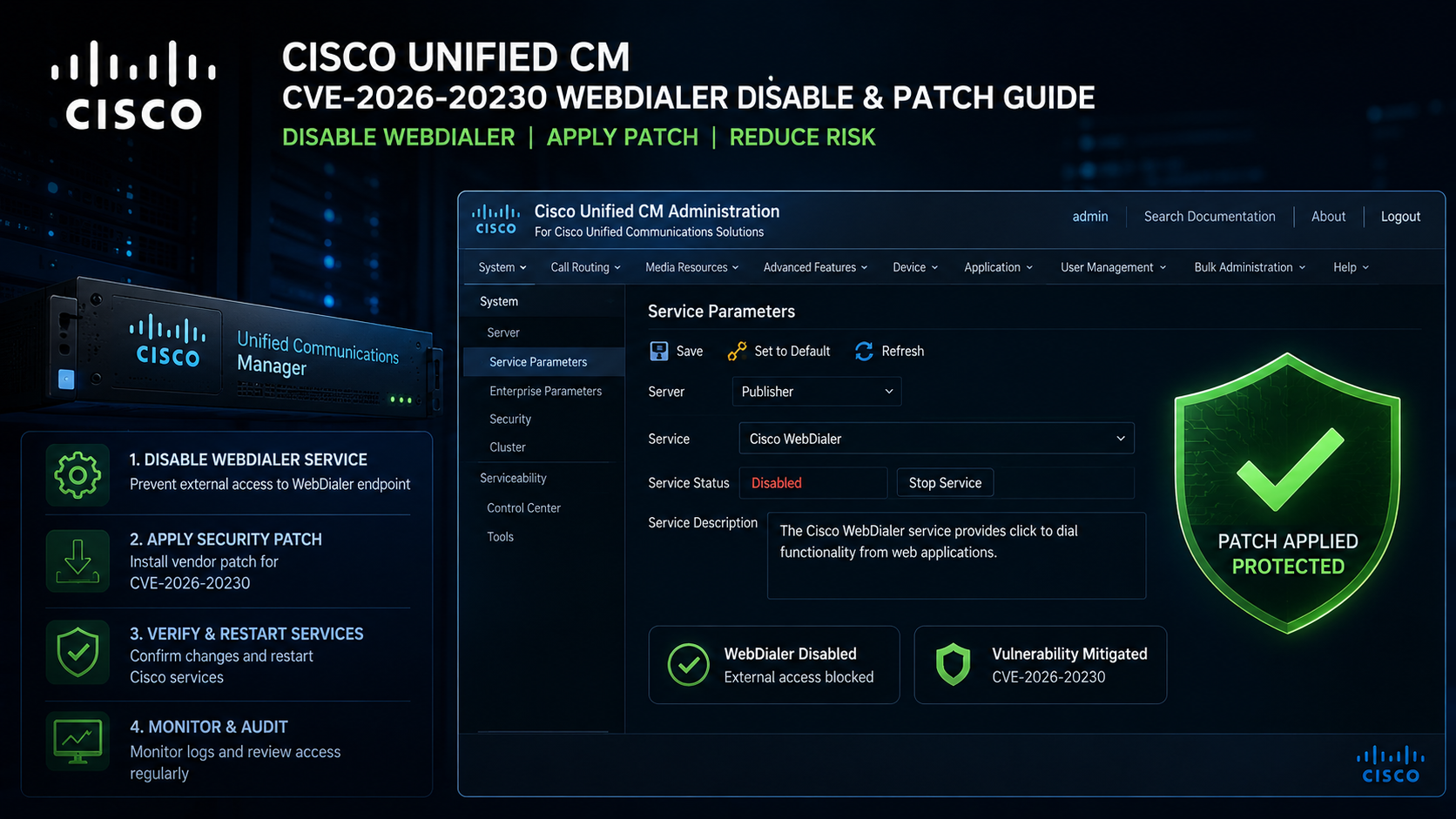
Why the Cisco Unified CM Flaw Matters Beyond This One Patch
This vulnerability points to a broader security issue. Enterprise communications platforms are often critical, trusted, and under-monitored. They may not receive the same security attention as web applications, identity platforms, or endpoint systems.
That creates opportunity for attackers. A communications platform can provide internal trust, service dependencies, credentials, and valuable operational visibility.
Security teams should treat Unified CM and similar platforms as high-value infrastructure. They deserve strict access control, regular patching, service review, log monitoring, and incident response planning.
Communications Platforms Are Undervalued Attack Targets
Voice and collaboration platforms often sit outside the main security conversation, even though they support critical business operations. They may handle call routing, voicemail, device registration, emergency communications, conferencing, and integrations with identity systems.
A compromise can affect more than phone calls. It can affect incident coordination, executive communications, customer support, and business continuity.
The Cisco Unified CM flaw shows why communications infrastructure must be part of the core security program.
Auxiliary Services Create Hidden Attack Surfaces
WebDialer is an auxiliary feature. Many organisations may not use it every day, but it can still remain enabled from an old deployment, test project, or legacy workflow.
This is a common enterprise risk. Optional services often remain active long after the original business need disappears. Attackers look for these forgotten services because they are less likely to be monitored.
Security teams should regularly audit optional services across major platforms and disable anything that is not actively required.
The Gap Between Patch and Attack Is Closing Fast
Cisco patched the flaw on June 3, 2026. Public proof-of-concept material and active exploitation reporting followed quickly. That timeline shows how little time defenders may have after a major platform advisory.
Organisations cannot rely on quarterly patch cycles for internet-reachable enterprise platforms. High-risk flaws affecting authentication, file writes, root access, SSRF, or public exploit code need emergency handling.
The practical lesson is to reduce exposure before the next vulnerability appears. Patch quickly, restrict access, disable unused services, and monitor critical platforms continuously.
No Workarounds Means Patching Is the Full Fix
Cisco states there are no workarounds that fully address the vulnerability. Disabling WebDialer removes the attack surface, but it does not change the fact that the vulnerable code must be updated.
That means patching is mandatory for long-term remediation. Disabling the service is an emergency exposure-reduction step, not a complete substitute.
Organisations should document WebDialer status, apply the Cisco update path, verify the service state, and perform forensic checks before closing the issue.
Key Takeaway on the Cisco Unified CM Flaw
The Cisco Unified CM flaw CVE-2026-20230 is an unauthenticated SSRF vulnerability in Cisco Unified Communications Manager and Unified CM SME. When WebDialer is enabled, attackers can send crafted HTTP requests that may lead to file writes on the operating system and later root privilege escalation.
Cisco patched the flaw on June 3, 2026 and rated the advisory Critical because of the root escalation path. Public exploit code and exploitation reporting increase the urgency.
Patch immediately. If you cannot patch today, disable WebDialer if it is not required. Then review logs, file writes, and system activity to confirm whether exploitation occurred before remediation.
What to Do Right Now
Check WebDialer status on every Unified CM and Unified CM SME node. Do not assume the service is off simply because it is disabled by default.
Disable WebDialer immediately wherever it is not actively needed. If it is required, restrict network access and patch without delay.
Upgrade affected Unified CM systems to Cisco’s fixed releases or apply the appropriate interim patch following Cisco’s advisory guidance.
Search /tmp and other writable directories for unexpected files created after June 3, 2026. Review WebDialer logs for file URL payloads, internal URL references, and suspicious request parameters.
Block public internet access to Unified CM management interfaces and WebDialer endpoints. Restrict access to trusted administrative networks only.
Escalate to incident response if you find unexpected file writes, web shell indicators, suspicious processes, unusual outbound connections, or unexplained configuration changes.
For broader exposure validation, see Digital Warfare’s penetration testing services.
Frequently Asked Questions About the Cisco Unified CM Flaw
What Is the Cisco Unified CM Flaw CVE-2026-20230?
The Cisco Unified CM flaw CVE-2026-20230 is a server-side request forgery vulnerability in Cisco Unified Communications Manager and Cisco Unified CM Session Management Edition. It affects deployments where the Cisco WebDialer Web Service is enabled.
Is the Cisco Unified CM Flaw Being Actively Exploited?
Yes. Public reporting has confirmed exploitation activity after Cisco released patches. Current activity has included scanning and file-write attempts against vulnerable WebDialer-enabled systems.
How Does the Cisco Unified CM Flaw Work?
The flaw works because WebDialer does not properly validate specific HTTP request input. An unauthenticated attacker can send crafted requests that trigger SSRF behavior and may allow file writes to the underlying operating system.
Why Is the Cisco Unified CM Flaw Dangerous?
The flaw is dangerous because successful exploitation can allow file writes that may later be used to elevate privileges to root. Root access on a Unified CM node can give attackers control over a critical enterprise communications platform.
Who Is Affected by CVE-2026-20230?
Organisations running Cisco Unified CM or Unified CM SME with the Cisco WebDialer Web Service enabled are affected. WebDialer is disabled by default, so administrators should verify service status on every node rather than assuming it is off.
How Should Organisations Respond?
Organisations should patch affected Unified CM systems immediately, disable WebDialer if it is not needed, restrict access to management and WebDialer endpoints, and review logs and file-system changes for signs of exploitation.

