

Introduction
Attackers are exploiting an Arista VeloCloud zero-day that can compromise enterprise SD-WAN management infrastructure without requiring credentials.
The vulnerability, tracked as CVE-2026-16812, affects on-premises VeloCloud Orchestrator deployments. Arista assigned the flaw a maximum CVSS 10.0 severity score because attackers only need network access to the VCO web interface. They do not need tenant credentials, operator credentials, user interaction, or prior access.
This is not a routine network appliance bug. VeloCloud Orchestrator acts as the control plane for SD-WAN deployments. It manages policies, configuration, routing, credentials, certificates, and connected VeloCloud Edge devices.
That makes the Arista VeloCloud zero-day a direct risk to the enterprise network fabric. A compromised orchestrator can expose the systems, configurations, and credentials that connect branch offices, data centers, cloud environments, and remote sites.
Arista has released fixed versions, confirmed active exploitation, shared attacker IP addresses, and published investigation guidance. CISA also added CVE-2026-16812 to the Known Exploited Vulnerabilities catalog and set a July 30, 2026 remediation deadline for federal agencies.
For related network infrastructure threat context, see Digital Warfare’s Russian FSB router exploitation analysis
Why the Arista VeloCloud Zero-Day Creates Maximum Enterprise Risk
The Arista VeloCloud zero-day creates maximum enterprise risk because VeloCloud Orchestrator controls the SD-WAN environment beneath it.
An attacker who compromises one workstation reaches one system. An attacker who compromises a network management platform can reach the infrastructure that manages many systems.
That difference matters.
VeloCloud Orchestrator manages SD-WAN configuration, routing policy, device inventory, certificates, credentials, and connected Edge devices. If attackers compromise the orchestrator, they may gain visibility into the entire SD-WAN deployment.
Arista warns that successful exploitation can compromise the confidentiality, integrity, and availability of the orchestrator and the data it manages.
The maximum severity score reflects the worst-case combination of conditions. The flaw is remotely reachable, unauthenticated, actively exploited, and tied to a high-value management plane.
What Happened: Active Exploitation Confirmed
Arista published Security Advisory 0144 on July 27, 2026.
The advisory confirms that CVE-2026-16812 was discovered externally and is known to be actively exploited.
That makes this a true zero-day from the defender’s perspective. Attackers had weaponized the flaw before customers had the public advisory and fixed versions available.
Arista also shared three IP addresses confirmed to have exploited the vulnerability: 8.19.75.217, 206.72.242.124, and 206.72.242.162.
Administrators should block those IP addresses immediately and review historical logs for any prior activity from them. However, Arista warns that the list is not exhaustive. Other attacker infrastructure may exist.
CISA added CVE-2026-16812 to the Known Exploited Vulnerabilities catalog on the same day Arista published the advisory. That escalation confirms the urgency for all organizations, not only federal agencies.
How CVE-2026-16812 Compromises VeloCloud Orchestrator
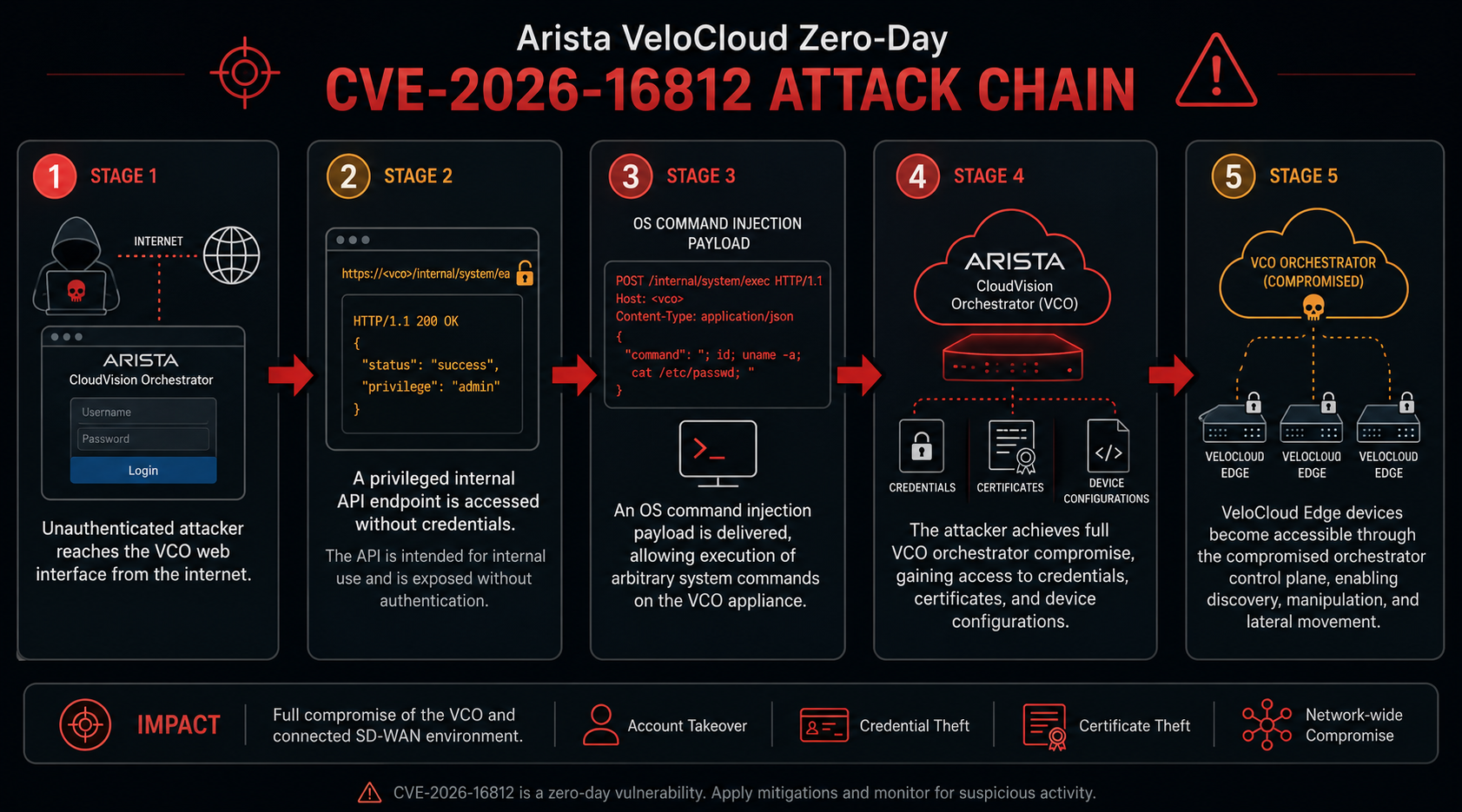
CVE-2026-16812 is an OS command injection vulnerability.
Command injection occurs when an application passes unsafe input to an operating system shell. If attackers control that input, they can force the system to run commands the application never intended to execute.
The severity comes from the context.
The vulnerable functionality was intended for internal use and should not be remotely accessible. Because attackers can reach it through the VCO web interface, they can access privileged functionality without authentication.
That means the vulnerable path was never designed to safely process external attacker-controlled requests.
Once attackers reach that path, they can affect the VCO host and the data managed by the orchestrator.
Why There Is No VCO Configuration Workaround
Arista states that VCO is exposed by default and that no VCO configuration can prevent the exposure.
This is one of the most important facts in the advisory.
Organizations cannot solve the risk by changing a setting inside VCO. They must patch, restrict network access, or both.
The strongest compensating control is network-layer restriction. Security teams should limit VCO web interface access to trusted administrative networks only and remove internet-facing access wherever possible.
Blocking confirmed attacker IP addresses helps, but it does not fully remediate the risk. Attackers can use other infrastructure.
Why SD-WAN Control Plane Compromise Is So Dangerous
The SD-WAN control plane manages how traffic moves across the enterprise.
VeloCloud Orchestrator can manage branch connectivity, routing policy, cloud access, device inventory, and Edge device configuration.
That makes it a crown jewel system.
If attackers compromise the orchestrator, they may access topology data, device configurations, credentials, certificates, cryptographic keys, database exports, and management functions.
They may also attempt unauthorized configuration changes or use stolen credentials after patching.
This is why patching alone is not enough for organizations that may already be compromised.
Affected Versions and Fixed Releases
The affected versions are on-premises VeloCloud Orchestrator deployments.
VCO 5.2.x releases before 5.2.3.14 are affected. The fixed version is 5.2.3.14.
VCO 6.1.x releases before 6.1.3.4 are affected. The fixed version is 6.1.3.4.
VCO 6.4.x releases before 6.4.2.4 are affected. The fixed version is 6.4.2.4.
VCO 7.0.x releases before 7.0.0.1 are affected. The fixed version is 7.0.0.1.
VeloCloud Orchestrator Hosted and Dedicated deployments were patched before the advisory was published and are not affected.
VeloCloud Gateway and VeloCloud Edge products are also not vulnerable to CVE-2026-16812.
Organizations running end-of-support VCO versions should treat the risk as unresolved and contact Arista Technical Assistance Center for upgrade guidance.
Timeline of the Arista VeloCloud Zero-Day
Attackers discovered and exploited CVE-2026-16812 before public disclosure.
On July 27, 2026, Arista published Security Advisory 0144, confirmed active exploitation, and released fixed VCO versions.
On the same day, CISA added CVE-2026-16812 to the Known Exploited Vulnerabilities catalog and set a July 30 remediation deadline for federal agencies.
Arista also published confirmed attacker IP addresses and investigation guidance.
The timeline matters because organizations should assume exploitation may have occurred before they patched.
Every vulnerable VCO instance requires both emergency remediation and compromise assessment.
Enterprise Impact of the Arista VeloCloud Zero-Day
The enterprise impact is severe because the vulnerability affects a management plane.
A compromised VCO instance can expose the SD-WAN environment it manages. That can include branch offices, data centers, cloud environments, remote locations, and connected Edge devices.
Attackers may gain access to network topology, routing policy, configuration archives, credentials, certificates, cryptographic keys, and device inventory.
They may also use the orchestrator’s management role to manipulate the environment or maintain access through stolen credentials.
For enterprises, this is not just a vulnerability management issue. It is a network control plane integrity issue.
For broader exposure review, see Digital Warfare’s <a href="https://digitalwarfare.com/vulnerability-assessments/">vulnerability assessment services</a>.
Why Internet-Exposed VCO Instances Face Immediate Risk
CVE-2026-16812 requires only network access to the VCO web interface.
That means any internet-exposed on-premises VCO instance running an affected version should be treated as high risk.
The attacker does not need a valid account. They do not need a tenant credential. They do not need operator access. They only need to reach the vulnerable interface.
Organizations should immediately identify whether any VCO web interface is reachable from untrusted networks.
If it is, restrict access before, during, and after patching.
Why Credential Rotation Must Follow Patching
Patching closes the vulnerability, but it does not erase anything attackers may have stolen.
If attackers accessed credentials, certificates, keys, or configuration archives before the patch, they may retain those materials after remediation.
That means organizations with suspected compromise should rotate credentials and review certificates connected to the SD-WAN environment.
They should also validate Edge device configurations and review administrator activity.
This is a common mistake in zero-day response. Teams patch the flaw and assume the incident is over. For a management platform, the real risk may persist through stolen access material.
Real-World Attack Scenarios
In an unauthenticated SD-WAN takeover scenario, an attacker scans the internet for exposed VCO web interfaces. They find an affected on-premises VCO instance, exploit CVE-2026-16812 without credentials, execute commands on the host, and extract device inventory, routing configuration, certificates, and credentials.
In a persistent configuration manipulation scenario, attackers compromise the orchestrator and make subtle routing policy changes. They avoid immediate disruption and instead redirect selected traffic flows through attacker-controlled infrastructure. The network still appears operational, but the control plane is no longer trustworthy.
In a credential harvest before patching scenario, attackers exploit the VCO instance before the advisory appears. The organization patches quickly after disclosure, but the attackers already copied credentials and certificates. Weeks later, they use stolen access material to interact with connected infrastructure.
These scenarios reflect the confirmed mechanics and enterprise implications of the advisory. They do not assume unsupported exploit details.
How to Remediate the Arista VeloCloud Zero-Day
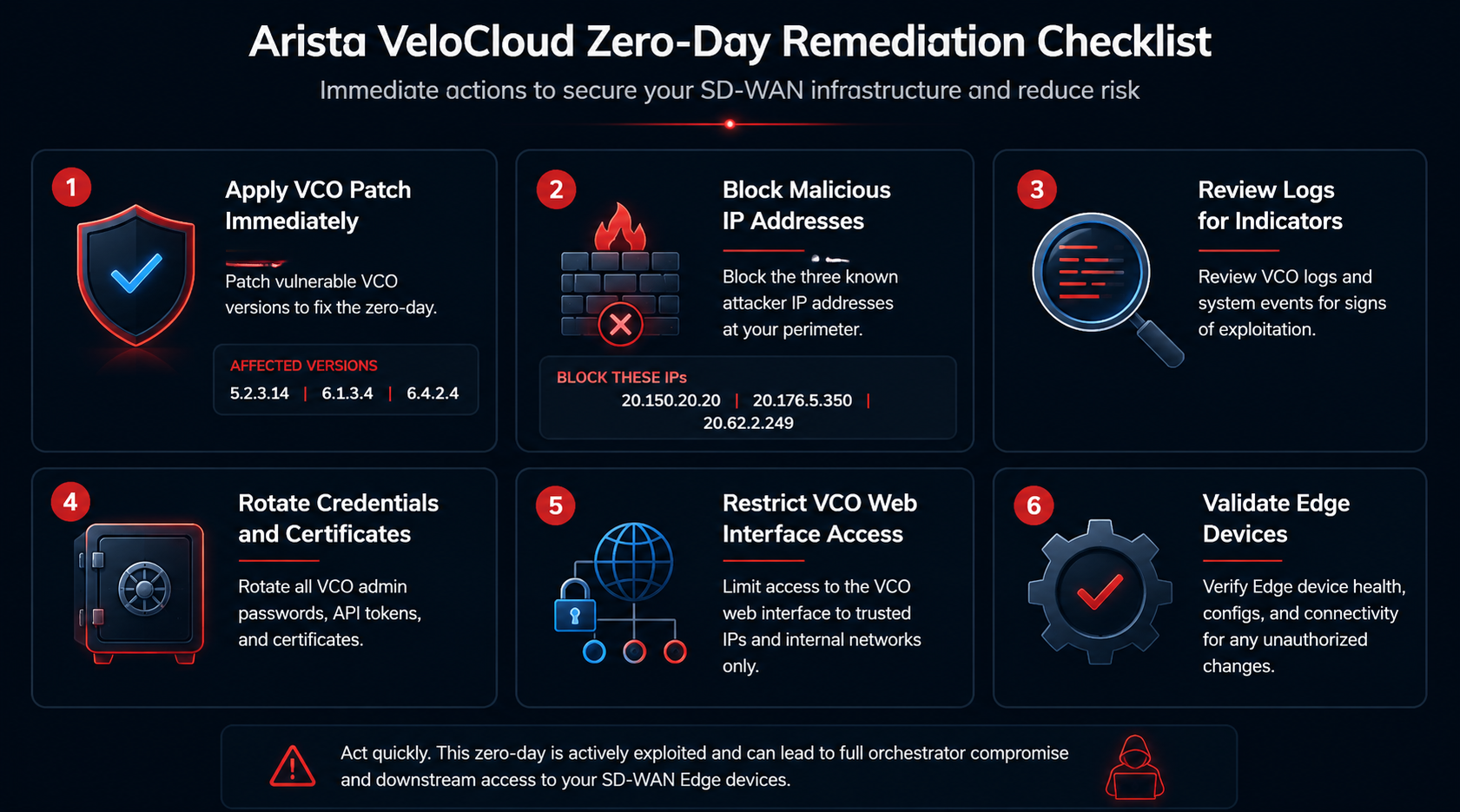
Remediation should follow a strict priority order.
First, patch VCO to the fixed version for the release branch. Second, restrict VCO web interface access to trusted administrative networks. Third, block confirmed attacker IP addresses. Fourth, preserve evidence if compromise is suspected. Fifth, review logs for exploitation indicators. Sixth, rotate credentials and validate connected Edge devices.
Do not treat this as a routine patch.
Because active exploitation has been confirmed, every vulnerable deployment requires both remediation and investigation.
Priority One: Patch VCO Immediately
Patch affected VCO branches immediately.
Upgrade VCO 5.2.x to 5.2.3.14 or later.
Upgrade VCO 6.1.x to 6.1.3.4 or later.
Upgrade VCO 6.4.x to 6.4.2.4 or later.
Upgrade VCO 7.0.x to 7.0.0.1 or later.
Organizations running unsupported versions should contact Arista TAC immediately.
A CVSS 10.0 flaw under active exploitation does not belong in the next routine maintenance window. It belongs in emergency change control.
Priority Two: Restrict VCO Web Interface Access
Restrict VCO web interface access to trusted administrative networks only.
This control matters because Arista states that exploitation requires network access to the VCO web interface and that no internal VCO configuration prevents exposure.
Use firewalls, access control lists, VPN requirements, bastion hosts, and management network segmentation to prevent untrusted sources from reaching VCO.
Remove direct internet exposure wherever possible.
This should remain in place after patching. Management platforms should never be broadly reachable.
Priority Three: Block Confirmed Attacker IP Addresses
Block the confirmed attacker IP addresses at perimeter firewalls, upstream controls, and host-level firewalls where appropriate.
The confirmed IP addresses are 8.19.75.217, 206.72.242.124, and 206.72.242.162.
Then review historical firewall, proxy, VCO web access, and system logs for prior connections from those addresses.
Blocking these IPs is not full protection. Arista warns the list is not definitive. Treat it as an immediate containment step, not the complete remediation plan.
Priority Four: Preserve Evidence Before Remediation if Compromise Is Suspected
If compromise is suspected, preserve logs and filesystem timestamps before making destructive changes.
Patching, restoring, or rebuilding systems can overwrite evidence that investigators need to determine scope, timeline, and impact.
Preserve VCO web access logs, system logs, database access logs, configuration archives, filesystem timestamps, administrator activity, outbound network logs, and relevant firewall data.
Then proceed with containment and remediation.
For incident investigation support, see Digital Warfare’s forensics services<.
Priority Five: Review VCO Logs for Exploitation Indicators
Review VCO logs for suspicious web requests, encoded characters, URL-like path components, references to internal services, unusual request rates, and access from confirmed attacker IP addresses.
Investigate unexpected outbound HTTP or HTTPS traffic from the VCO host.
Look for unauthorized configuration changes, privileged maintenance activity, unexpected command execution, new files, database exports, archive files, and suspicious access to configuration data.
Pay special attention to access involving credentials, certificates, cryptographic keys, device inventory, and SD-WAN topology data.
A clean patch result does not prove the system was never exploited.
Priority Six: Rotate Credentials and Validate Edge Devices
Rotate credentials managed by or accessible through the VCO instance if compromise is confirmed or suspected.
Review certificates and cryptographic keys that the orchestrator manages.
Validate connected VeloCloud Edge devices for unauthorized configuration changes.
Review administrator accounts, privileged actions, policy changes, routing changes, device inventory changes, and certificate activity during the exposure window.
Consider restoring or replacing compromised instances when the integrity of the VCO host cannot be trusted.
For proactive control-plane security testing, see Digital Warfare’s penetration testing services
What Security Teams Should Monitor
Security teams should monitor VCO web access logs, system logs, firewall logs, proxy logs, outbound traffic logs, database access logs, and administrator activity.
They should look for connections from confirmed attacker IP addresses, unexpected outbound HTTP or HTTPS traffic, encoded request patterns, internal service references, unusual archive creation, unexplained database exports, and unexpected file creation.
They should also monitor VeloCloud Edge devices for configuration changes, certificate changes, routing policy changes, and communication with unfamiliar destinations.
For related edge and browser exposure management, see Digital Warfare’s Microsoft Edge security analysis
Broader Security Lessons From the Arista VeloCloud Zero-Day
The Arista VeloCloud zero-day reinforces a critical enterprise security lesson. Control planes are crown jewels.
Any platform that manages network devices, routing, identity, certificates, cloud access, or branch connectivity should receive the highest protection tier.
That means restricted administrative access, continuous monitoring, strong authentication, emergency patching, segmented management networks, tested recovery plans, and compromise assessment after exploited vulnerabilities.
The second lesson is that actively exploited zero-days require investigation, not only patching.
Patching closes the flaw. It does not remove stolen credentials, reverse configuration changes, or prove that attackers never accessed sensitive management data.
The third lesson is that end-of-support software creates unacceptable uncertainty. Arista has not assessed unsupported versions for this vulnerability. Running unsupported network management software leaves organizations without confirmed exposure status or a reliable remediation path.
Why SD-WAN Management Platforms Need Stronger Governance
SD-WAN management platforms control business connectivity.
They shape how branch offices, data centers, cloud services, and remote sites communicate. They also hold sensitive configuration and trust material.
That makes them more important than ordinary infrastructure servers.
Security teams should treat SD-WAN management access like domain administration. Restrict it, monitor it, log it, test it, and review it after every critical vulnerability.
Executives should know who owns the platform, who can access it, whether it is internet-reachable, how quickly it can be patched, and what happens if it is compromised.
Why This Zero-Day Is Evergreen for Enterprise Security
The vulnerability is current, but the lesson is evergreen.
Attackers will continue targeting network management platforms because they provide control over many systems at once.
Enterprises will continue relying on SD-WAN, cloud networking, remote sites, branch connectivity, and centralized management.
That combination means management plane security will remain a long-term priority.
The right response is not just patching one CVE. The right response is building an operating model where control-plane systems receive emergency patch priority, strict access controls, and continuous monitoring by default.
Key Takeaway on the Arista VeloCloud Zero-Day
The Arista VeloCloud zero-day is a maximum-severity risk because it affects the SD-WAN control plane.
CVE-2026-16812 allows unauthenticated attackers with network access to the VCO web interface to reach privileged internal functionality and impact the VCO host.
Arista confirmed active exploitation and released fixed versions for affected on-premises VCO branches. CISA added the flaw to the Known Exploited Vulnerabilities catalog.
Organizations should patch immediately, restrict VCO web interface access, block confirmed attacker IP addresses, preserve evidence where compromise is suspected, review logs, rotate credentials, and validate connected Edge devices.
This is not only a patching issue. It is a control-plane integrity issue.
What Organizations Should Do Now
Identify every on-premises VeloCloud Orchestrator instance.
Confirm the installed VCO branch and version.
Patch to 5.2.3.14, 6.1.3.4, 6.4.2.4, 7.0.0.1, or later depending on the branch.
Restrict VCO web interface access to trusted administrative networks.
Block 8.19.75.217, 206.72.242.124, and 206.72.242.162.
Review historical logs for connections from those IP addresses.
Search VCO logs for suspicious encoded requests, internal service references, unusual request rates, unexpected outbound traffic, unauthorized configuration changes, command execution, file creation, database exports, and archive creation.
Preserve forensic evidence before remediation if compromise is suspected.
Rotate credentials, certificates, and keys that may have been exposed.
Validate connected VeloCloud Edge devices for unauthorized changes.
For the one external source in this article, review Arista’s official advisory:Arista Security Advisory 0144

