

Introduction
A COLDCARD RNG flaw exposed a serious hardware wallet security risk by weakening the randomness used to generate Bitcoin wallet seeds on affected firmware versions.
Coinkite published a security advisory warning that seeds generated on affected COLDCARD firmware may be at risk if users created them without enough independent dice entropy and without a strong, unique BIP-39 passphrase.
The issue affects multiple COLDCARD models and firmware tracks. Coinkite has released fixed firmware for affected devices, but users need to understand one critical point: updating firmware does not repair a seed that was already generated on vulnerable firmware.
That means affected users must migrate funds to a newly generated wallet seed after installing fixed firmware.
This article explains how the COLDCARD RNG flaw works, which versions are affected, why predictable seed generation breaks the hardware wallet trust model, and how users should migrate funds safely.
For related cryptographic risk analysis, see Digital Warfare’s wolfSSL vulnerability analysis on cryptographic trust failures.
Why the COLDCARD RNG Flaw Matters
The COLDCARD RNG flaw matters because hardware wallets depend on one foundational assumption: the wallet must generate unpredictable secrets.
A hardware wallet can have excellent physical security, strong signing protections, and offline key storage. But if the seed phrase itself is generated from weak or predictable randomness, every other security layer loses value.
Bitcoin wallets rely on seed phrases to generate private keys. If attackers can predict or narrow the possible seed space, they can derive matching wallet addresses and private keys without touching the device.
That is what makes random number generation so important.
Hardware wallet users often assume that an offline device automatically means strong security. This incident shows that security also depends on correct firmware behavior, correct entropy source selection, and safe failure handling when a randomness source does not behave as expected.
What Happened: Coinkite Publishes COLDCARD Advisory
Coinkite published a COLDCARD security advisory on July 30, 2026, and updated it on August 1.
The advisory states that funds controlled by seeds generated on affected firmware are at risk if the seed was created without at least 50 independent, private dice rolls and the funded wallet is not protected by a strong, unique BIP-39 passphrase.
Coinkite released fixed firmware for every affected model and release track.
The affected device families include Mk2, Mk3, Mk4, Mk5, and Q devices across standard and Edge firmware tracks.
Coinkite also states that TAPSIGNER, OPENDIME, and SATSCARD products are not affected because they use different codebases.
The most important user action is not only updating firmware. Users who generated seeds on affected firmware should migrate funds to a newly generated seed after installing fixed firmware unless the independent dice-entropy exception applies.
How the COLDCARD RNG Flaw Works
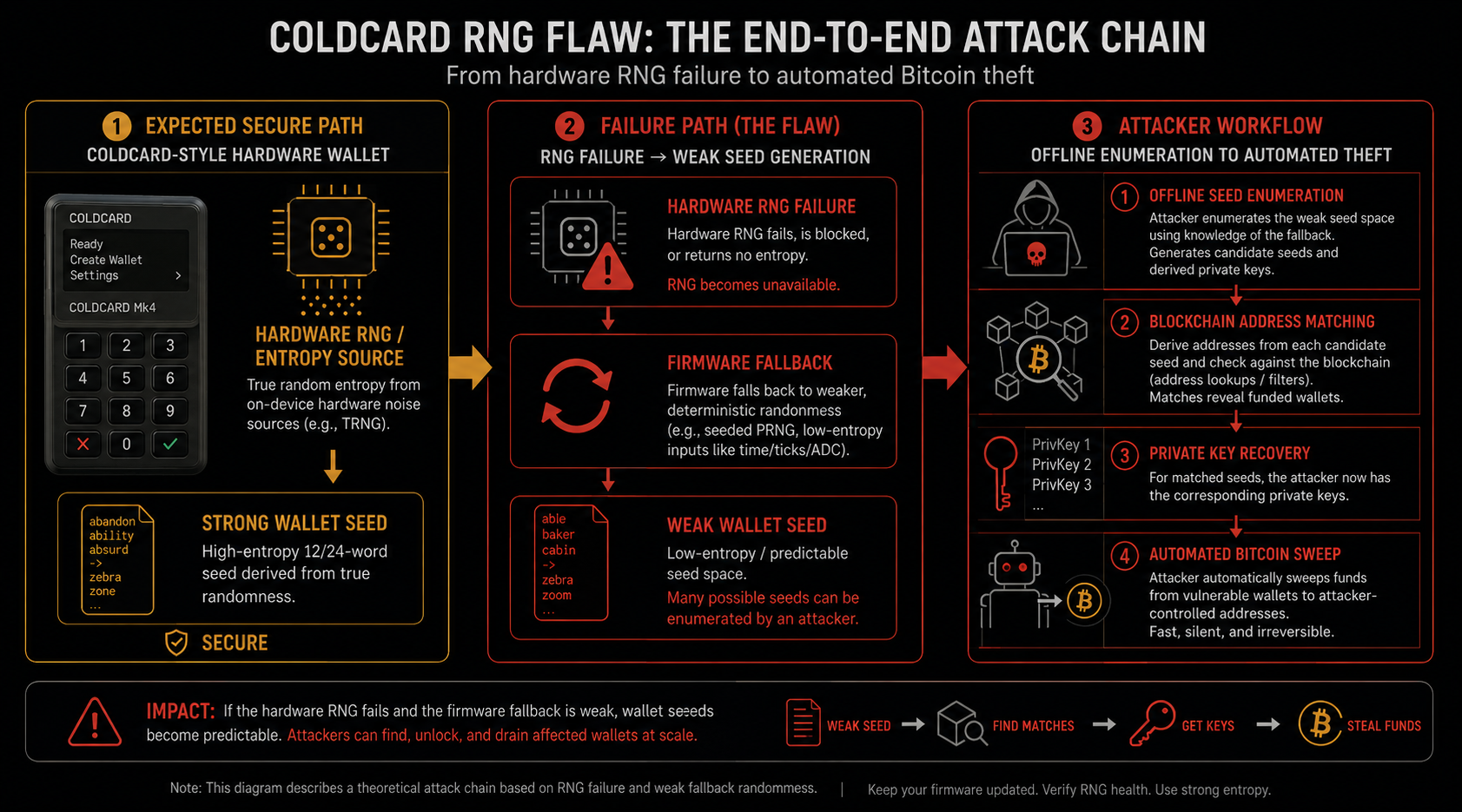
The COLDCARD RNG flaw involves how affected firmware handled random number generation during seed creation.
A secure hardware wallet should generate wallet seeds using high-quality cryptographic randomness. The device should draw entropy from a secure source and fail safely if that source is unavailable or not functioning correctly.
The issue described in public reporting and the vendor advisory centers on affected firmware generating seeds with reduced entropy.
When entropy is reduced, the number of possible seed combinations becomes smaller than expected. Attackers can then attempt offline enumeration of possible seeds, derive associated Bitcoin addresses, and compare them against public blockchain data.
If an attacker finds a match, they can derive the corresponding private keys and move the funds.
This is especially dangerous because the attacker does not need malware on the device, network access to the wallet, or physical possession of the hardware wallet. The preparation can happen offline.
Why Reduced Entropy Breaks Hardware Wallet Security
Entropy is the uncertainty that protects a wallet seed from guessing.
A properly generated seed should be impossible to predict. The number of possible combinations should be so large that brute force is infeasible.
When a random number generation flaw reduces entropy, that security margin collapses.
The wallet may still look normal. The seed phrase may still have the correct number of words. The device may still sign transactions correctly. But the seed may come from a much smaller set of possibilities than users expect.
That creates a hidden failure. Users cannot look at a seed phrase and know whether the randomness behind it was strong.
This is why cryptographic systems must fail loudly when secure randomness is unavailable. Silent fallback to weaker randomness creates systemic risk.
Affected COLDCARD Versions and Fixed Firmware
Coinkite lists fixed firmware for each affected model and release track.
Mk2 and Mk3 devices should run firmware version 4.2.0 or later.
Mk4 and Mk5 standard devices should run version 5.6.0 or later.
Mk4 and Mk5 Edge devices should run version 6.6.0X or later.
Q standard devices should run version 1.5.0Q or later.
Q Edge devices should run version 6.6.0QX or later.
Coinkite warns that Standard and Edge are separate release tracks. Users should install the fixed release for their specific model and track rather than assuming a higher-looking version number in another track is safe.
The advisory also says users should not generate a new seed on affected models until fixed firmware is installed.
Which Seeds Are at Risk
According to Coinkite, seeds generated on Mk2 or Mk3 firmware versions 4.0.1 through 4.1.9 are at risk if created without at least 50 fair, independent, private dice rolls and without protection from a strong, unique BIP-39 passphrase.
Coinkite also states that seeds generated on Mk4, Mk5, and Q devices before the fixed firmware releases are affected, though the impact is less severe than for Mk2 and Mk3.
The key point is that affected seeds remain affected after a firmware update.
Updating the device fixes future seed generation. It does not change the seed phrase already written down and used to control funds.
If a wallet seed was created on affected firmware and does not fall under the dice-roll exception, users should migrate funds.
Dice Rolls and BIP-39 Passphrases
Coinkite says the issue affects device-generated entropy. It does not remove independent entropy supplied by the user through dice rolls.
If a user entered at least 50 fair, independent, private dice rolls when creating the seed, Coinkite does not consider that seed at risk from this RNG issue alone.
The advisory also explains that a strong, unique BIP-39 passphrase adds an independent barrier. However, a passphrase does not repair the affected seed.
A weak, reused, common, patterned, or guessable passphrase may not provide meaningful protection.
Users who are uncertain about how many dice rolls they used, whether the dice rolls remained private, or whether their passphrase is strong should migrate to a new seed on fixed firmware.
Why Updating Firmware Alone Is Not Enough
Updating firmware is necessary, but it is not sufficient for existing wallets.
A firmware update fixes the device’s future behavior. It does not change the seed already generated.
If attackers can enumerate or reconstruct the seed space from affected firmware behavior, a patched device cannot make the old seed stronger.
This is the most important remediation point.
Users should not stop after updating. They must generate a fresh seed on fixed firmware and move funds to a new wallet if their existing seed falls within the affected conditions.
This is similar to rotating a compromised password. Fixing the password manager does not protect an old password that attackers may already know or guess.
Public Theft Reporting and What Remains Unconfirmed
Your draft references public research estimates that attackers stole up to $88.6 million in Bitcoin across thousands of addresses.
However, the most authoritative source available here is Coinkite’s own advisory, and the advisory focuses on affected firmware, fixed versions, risk conditions, and migration steps. It does not confirm the full theft amount in the same way the draft presents it.
Public reporting also contains different theft estimates.
For that reason, this final version avoids presenting the $88.6 million figure as a settled vendor-confirmed fact. The safer wording is that public reporting and blockchain analysis have linked the flaw to large-scale Bitcoin theft, while Coinkite confirms the technical risk and migration requirements.
This keeps the article accurate and protects Digital Warfare’s authority.
Enterprise and Individual Impact
The COLDCARD RNG flaw affects individual wallet users, but the security lesson matters to enterprises too.
Cryptographic devices are widely used beyond cryptocurrency. Enterprises rely on hardware security modules, signing devices, authentication tokens, embedded secure elements, key management systems, and cryptographic libraries.
All of those systems depend on correct randomness.
If the entropy source fails, every dependent control can fail with it.
For Bitcoin holders, the direct impact is immediate financial risk. For enterprises, the broader lesson is that cryptographic implementation quality matters as much as the cryptographic algorithm itself.
A strong algorithm cannot protect a weakly generated key.
Why Hardware Wallet Trust Depends on Firmware
Hardware wallets are trusted because they isolate private keys from internet-connected computers.
But firmware controls how the device generates, stores, displays, signs, and protects those keys.
That means firmware quality is part of the hardware wallet’s security boundary.
A hardware wallet is not secure simply because it is offline. It must also generate keys correctly, verify addresses correctly, protect secrets correctly, and fail safely when internal assumptions break.
The COLDCARD RNG flaw shows how a firmware integration issue can undermine the security model without requiring a physical attack against the device.
Why Offline Attacks Are So Dangerous
Offline seed enumeration creates almost no detection opportunity.
A traditional compromise may involve malware, login attempts, network traffic, suspicious processes, or device interaction.
This type of attack can happen without touching the victim’s wallet.
An attacker can generate candidate seeds, derive possible Bitcoin addresses, compare them against public blockchain data, and prepare transactions before the victim sees any warning.
The first visible sign may be funds leaving the wallet.
That makes prevention and migration far more important than detection after the fact.
Real-World Attack Scenarios
A long-term holder creates a COLDCARD wallet on affected firmware and stores Bitcoin in the wallet for several years. The device appears to work normally. The user never sees an error. If the seed has reduced entropy, attackers may be able to derive the wallet offline and sweep the funds before the user understands the risk.
A security-conscious user creates a seed with more than 50 independent private dice rolls. The additional dice entropy protects the seed from this specific issue because the final seed includes user-supplied randomness beyond the affected device entropy.
Another user updates firmware immediately after reading the advisory but keeps using the old seed. That user may still be exposed because the old seed was generated before the fix. The correct action is to generate a new seed after installing fixed firmware and migrate funds.
These scenarios reflect the advisory’s technical guidance and the practical consequences of reduced entropy.
How to Migrate Your COLDCARD Wallet Safely
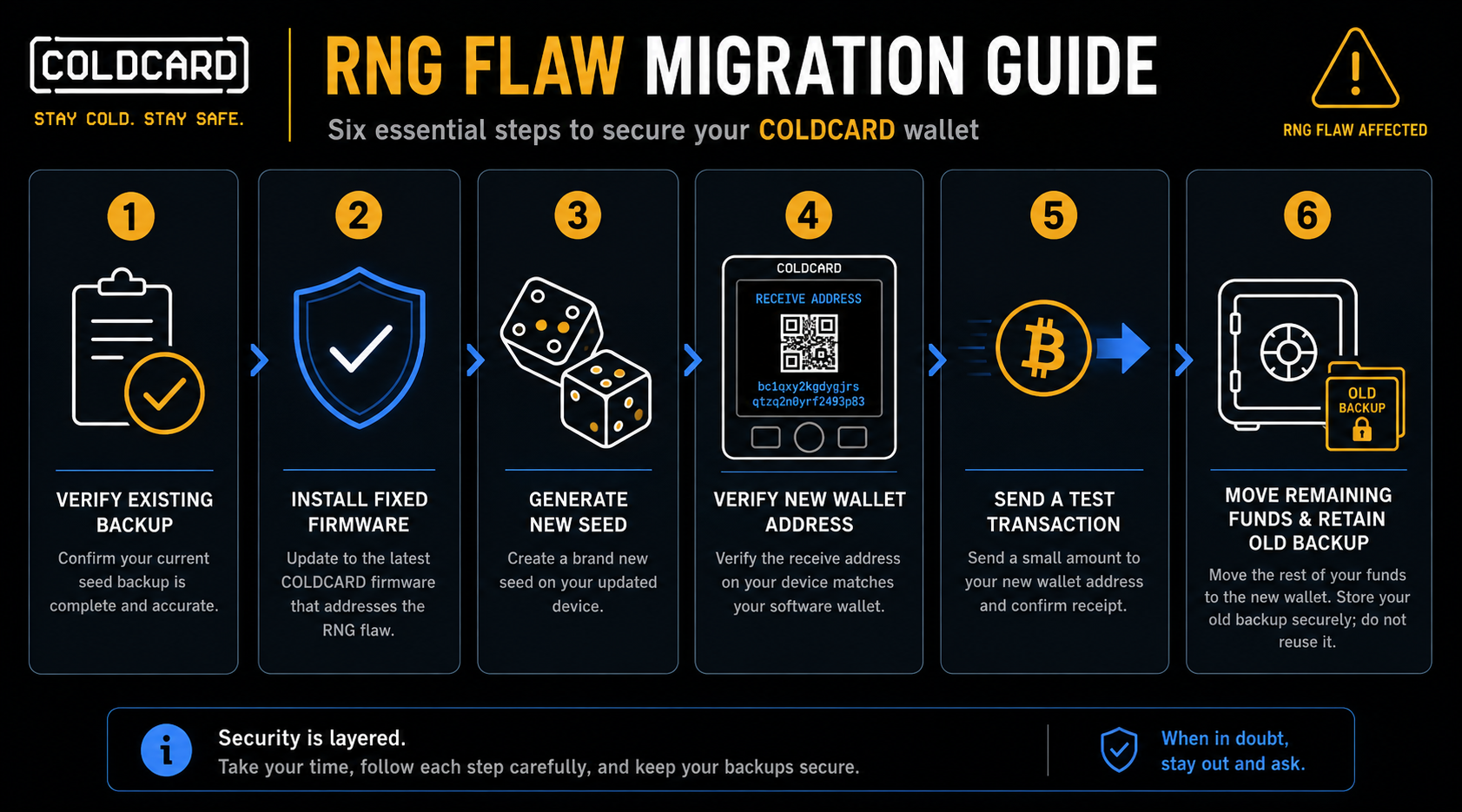
Migration should be careful, not rushed.
Coinkite’s guidance is clear: users should update to fixed firmware before generating a replacement seed, verify backups, test the new wallet, and only then move remaining funds.
Rushing a wallet migration can create a new loss event. A mistake in backup recording, address verification, or seed handling can be just as damaging as the vulnerability.
The safest approach is controlled, documented, and verified at each step.
Priority One: Verify Your Existing Backup
Before changing anything, verify that your current seed backup is complete and readable.
You need the old backup until the migration finishes and the full balance has arrived in the new wallet.
Do not destroy, discard, or overwrite the old backup too early.
If the device is your only way to access the old wallet, plan the migration carefully before resetting or generating a new seed.
Priority Two: Install Fixed Firmware
Install the fixed firmware for your exact COLDCARD model and release track.
Mk2 and Mk3 users should install version 4.2.0 or later.
Mk4 and Mk5 standard users should install version 5.6.0 or later.
Mk4 and Mk5 Edge users should install version 6.6.0X or later.
Q standard users should install version 1.5.0Q or later.
Q Edge users should install version 6.6.0QX or later.
Confirm the installed version on the device screen before generating a new seed.
Priority Three: Generate a New Seed on Fixed Firmware
After installing fixed firmware, generate a completely new seed.
Do not reuse the old seed. Do not assume the firmware update repaired it.
Write down the new seed carefully and store it offline.
If you choose to use dice rolls, follow Coinkite’s instructions exactly. Dice rolls are powerful only when they are fair, independent, private, and recorded correctly.
Priority Four: Verify the New Wallet Address
Before moving funds, verify that the new receive address shown in your wallet software matches the address displayed on the COLDCARD screen.
This step protects against address substitution attacks and user error.
Do not trust a computer display alone. The hardware wallet screen is the trusted display.
Priority Five: Send a Small Test Transaction
Send a small test transaction to the new wallet.
Wait for confirmation and verify that the new wallet receives it correctly.
This proves the new seed, backup, address verification, and transaction workflow work before you move the full balance.
Priority Six: Move the Remaining Funds
After the test transaction succeeds, move the remaining funds from the old wallet to the new wallet.
Keep the old backup until the migration is fully complete and confirmed.
Document the migration date, device firmware version, new wallet fingerprint, and confirmation that the full balance arrived.
For cryptographic implementation assurance, see Digital Warfare’s secure code review services.
What Security Teams Should Learn From the COLDCARD RNG Flaw
Security teams should treat random number generation as a critical dependency.
Randomness is not a low-level implementation detail. It is the foundation of key generation, authentication, encryption, signing, token creation, session management, and wallet security.
Any system that generates secrets should have testable guarantees around entropy source selection, fallback behavior, health checks, failure modes, and logging.
A silent fallback from hardware randomness to weaker deterministic behavior should not happen in security-sensitive systems.
When randomness fails, the system should fail closed, alert the user, and prevent key generation.
Broader Security Lessons From the COLDCARD RNG Flaw
The first lesson is that cryptographic security depends on implementation quality.
The second lesson is that hardware security devices need independent cryptographic review.
The third lesson is that fallback mechanisms can become vulnerabilities if they silently reduce security.
The fourth lesson is that public blockchain data can turn weak key generation into large-scale theft because attackers can match candidate addresses against visible balances.
The fifth lesson is that patching does not always remediate previously generated secrets.
That final point matters across enterprise security. If a vulnerability weakens generated keys, tokens, certificates, or seeds, remediation requires rotation or migration, not only software updates.
Why This Article Is Evergreen for Enterprise Security
The COLDCARD RNG flaw is current, but the lesson is evergreen.
Enterprises depend on cryptographic secrets everywhere. API keys, SSH keys, TLS certificates, signing keys, encryption keys, hardware tokens, service credentials, backup keys, and wallet seeds all depend on strong randomness.
When key generation fails, security can fail silently.
This is why organizations need secure development practices, cryptographic review, key rotation playbooks, hardware assurance, and strong incident response for cryptographic failures.
Digital Warfare’s position is simple: cryptographic systems should not be trusted only because they use strong algorithms. They must also generate, store, rotate, and validate secrets correctly.
Key Takeaway on the COLDCARD RNG Flaw
The COLDCARD RNG flaw shows how a hardware wallet can fail at the most important step: generating unpredictable wallet seeds.
Coinkite has released fixed firmware and migration guidance for affected users.
The most important point is that updating firmware does not repair existing seeds generated on affected firmware. Users who fall within the affected conditions should generate a new seed on fixed firmware and migrate funds carefully.
The broader enterprise lesson is that cryptographic implementation details matter. A predictable seed, key, token, or certificate can collapse an otherwise strong security model.
What COLDCARD Users Should Do Now
Check your COLDCARD model and firmware version.
Confirm whether your wallet seed was generated on affected firmware.
Determine whether you used at least 50 fair, independent, private dice rolls during seed generation.
Review whether you used a strong, unique BIP-39 passphrase.
Install the fixed firmware for your exact model and release track.
Generate a new seed on fixed firmware if your existing seed falls within the affected conditions.
Verify your new backup and wallet address.
Send a small test transaction first.
Move the remaining funds only after confirming the new wallet works.
Keep the old backup until the migration is fully complete.
For the one external authoritative source in this article, review Coinkite’s official advisory: COLDCARD Security Advisory

