
Introduction
Multiple wolfSSL vulnerabilities now expose billions of connected devices to certificate validation risk. One flaw, CVE-2026-5194, stands out because it can weaken the trust model that secures encrypted communication.
wolfSSL fixed the issue in version 5.9.1. The release addressed 21 security issues, including the critical certificate verification flaw tracked as CVE-2026-5194. This bug affects wolfSSL versions from 3.12.0 up to, but not including, 5.9.1.
The risk matters because wolfSSL powers encrypted communication across more than 5 billion applications and devices worldwide. Developers use it in embedded systems, IoT products, routers, industrial devices, automotive platforms, and other resource-constrained environments.
As a result, this is not just a library patch. It is a software supply chain issue. Security teams must identify where wolfSSL exists, confirm which builds are affected, and verify that vendors have integrated the fix.
For related supply chain risk context, see Digital Warfare’s curl flaw CVE-2026-8932 analysis
Why Multiple wolfSSL Vulnerabilities Matter
Multiple wolfSSL vulnerabilities matter because wolfSSL sits in a different part of the ecosystem than many mainstream TLS libraries. OpenSSL dominates much of the traditional web infrastructure space, but wolfSSL often appears inside embedded devices and firmware.
That deployment pattern changes the risk. A browser library can receive an update through normal software channels. However, an embedded TLS library inside a router, sensor, smart appliance, medical device, or industrial controller may remain unchanged for years.
Therefore, the real challenge is not only patch availability. The larger challenge is patch reach. Manufacturers may delay firmware updates, discontinue older products, or fail to notify customers clearly.
Even when a fixed firmware version exists, many users never install it. This creates long-tail exposure where vulnerable devices continue running in production long after upstream wolfSSL has shipped a patch.
How Multiple wolfSSL Vulnerabilities Expose Trust
The most serious issue in this release is CVE-2026-5194. The vulnerability affects certificate verification logic. Specifically, missing hash and digest size checks, combined with missing OID checks, may allow digests smaller than required to pass signature verification.
This weakens certificate-based authentication. If attackers can craft a certificate that passes verification when it should fail, they may be able to impersonate a trusted server, file, update path, or connection.
That does not mean every wolfSSL deployment is exploitable in the same way. Exploitability depends on how wolfSSL is built, which algorithms are enabled, and where certificate verification occurs.
However, the impact can be serious in affected builds. A device that trusts a forged certificate may connect to an attacker-controlled server, accept malicious content, or process a fake update as legitimate.
What Happened in CVE-2026-5194
wolfSSL released version 5.9.1 on April 8, 2026. That release patched CVE-2026-5194 and 20 additional security issues.
The flaw affects ECDSA/ECC verification when EdDSA or ML-DSA is also enabled. According to the public vulnerability description, missing digest size and OID validation can allow smaller-than-allowed digests during signature verification.
wolfSSL credited Nicholas Carlini of Anthropic for reporting the issue. Current reporting says Carlini identified the flaw through AI-assisted vulnerability research.
The fix added stricter validation around hash and digest sizes, along with checks that match signature OIDs against key OIDs. In short, wolfSSL added validation that should have rejected unsafe inputs earlier.
How CVE-2026-5194 Breaks Certificate Verification

Digital certificates depend on cryptographic signatures. During verification, the system must confirm that the certificate signature matches the expected algorithm, key type, digest size, and trust chain.
CVE-2026-5194 breaks this process by allowing unsafe combinations to pass in some conditions. The missing digest size checks create one gap. The missing OID checks create another.
A digest is the output of a hashing process. It must be the correct size for the algorithm and key type in use. If a verifier accepts a digest that is too small, it reduces the strength of the verification process.
Meanwhile, OIDs define which cryptographic algorithm and parameter family apply. If the verifier fails to enforce OID agreement properly, it may process a signature under assumptions that do not match the certificate’s real structure.
Together, these validation gaps can weaken certificate trust.
Why Multiple wolfSSL Vulnerabilities Need OID Validation
OID validation matters because cryptographic systems depend on strict agreement between the certificate, key, signature algorithm, and verification logic.
If wolfSSL receives a certificate signed under one algorithm expectation but validates it under a looser or mismatched expectation, the system may accept something it should reject.
That kind of mistake is dangerous because the underlying cryptographic algorithms may still be strong. The failure happens in the surrounding validation logic.
Therefore, security teams should not assume that enabling TLS automatically means trust is correct. TLS security depends on implementation details, certificate handling, algorithm checks, hostname validation, and application behavior.
How Multiple wolfSSL Vulnerabilities Are Patched in 5.9.1
wolfSSL 5.9.1 adds stricter checks for digest sizes and OID agreement. These changes reduce the chance that unsafe or mismatched certificate inputs pass verification.
The fix does more than adjust a minor rule. It adds validation logic that should reject inputs that previously had too much room to pass.
Organizations that build directly against wolfSSL should update to 5.9.1 or later. They should also rebuild applications, firmware, containers, and SDKs that statically link older wolfSSL versions.
In addition, teams should test the patched certificate verification path. A version number alone is helpful, but verified remediation is stronger.
Other High-Severity Multiple wolfSSL Vulnerabilities
CVE-2026-5194 is the most visible issue, but it is not the only flaw fixed in wolfSSL 5.9.1.
The same release addressed 21 security issues in total. Public reporting notes that several of the other issues carry high severity classifications.
Some of these vulnerabilities involve memory safety risks, crashes, destabilization, or exposure of protected content. The exact impact depends on the product, build configuration, and how wolfSSL is used.
Because of this, teams should treat wolfSSL 5.9.1 as a broad security update, not a one-CVE patch. Updating the library closes multiple issues at once.
Timeline of Multiple wolfSSL Vulnerabilities
Nicholas Carlini of Anthropic identified CVE-2026-5194 in early 2026.
On April 8, 2026, wolfSSL released version 5.9.1. The release fixed CVE-2026-5194 and additional security issues.
After the release, vulnerability databases and security outlets published coverage of the disclosure. NVD documented the affected version range as wolfSSL 3.12.0 up to, but not including, 5.9.1.
Security teams should use this timeline to guide exposure review. Any product, container, firmware image, or application built against an affected version before the patch date needs validation.
Enterprise Risk From Multiple wolfSSL Vulnerabilities
Multiple wolfSSL vulnerabilities create enterprise risk because organizations often do not know where wolfSSL exists.
Many teams do not install wolfSSL directly. Instead, they inherit it through vendor firmware, embedded SDKs, Linux packages, appliances, industrial systems, network devices, or third-party software.
That means a normal software inventory may miss the exposure. A server package scan may show no issue while a vendor appliance still runs a vulnerable embedded build.
Enterprises should ask vendors direct questions. Does the product use wolfSSL? Is it statically linked? Which version is present? Does the build enable ECC with EdDSA or ML-DSA? Which firmware version contains the fix?
IoT Risk From Multiple wolfSSL Vulnerabilities
IoT and consumer devices face long-tail exposure. Many devices ship with embedded TLS libraries and then receive few or no updates after release.
Smart home hubs, routers, sensors, cameras, appliances, gaming systems, and similar devices may rely on wolfSSL internally. Users may never see that dependency.
This makes risk communication difficult. Customers cannot patch what they cannot identify. Manufacturers need to publish clear advisories, fixed firmware versions, and end-of-life guidance.
If a device cannot receive a patch, users should consider network isolation, traffic monitoring, or replacement.
Industrial Risk From Multiple wolfSSL Vulnerabilities
Industrial environments often run on long equipment lifecycles. Systems may remain in service for a decade or more, especially in manufacturing, energy, transportation, and utilities.
If those systems use vulnerable wolfSSL builds, remediation may require vendor coordination, downtime planning, testing, and change control.
That process takes time. Therefore, operators should begin inventory work now rather than wait for exploit activity.
Critical infrastructure teams should prioritize systems that use certificate-based authentication for remote access, update channels, telemetry, device management, or control-plane communication.
Vendor Risk From Multiple wolfSSL Vulnerabilities
Vendor-supplied products create a verification challenge. A vendor may use wolfSSL internally without exposing that detail in public documentation.
Security teams should request concrete evidence. Marketing statements are not enough. Vendors should provide the affected component, fixed version, build number, release date, and confirmation of which cryptographic options are enabled.
Where vendors cannot provide clear answers, organizations may need to test the product themselves or apply compensating controls.
For broader vendor review support, see Digital Warfare’s vendor risk assessment services
Compliance Risk for Regulated Organizations
Organizations in regulated sectors should document this disclosure in their vulnerability and supply chain risk processes.
The flaw references digest size handling and certificate validation. That matters for organizations that depend on cryptographic controls for compliance, secure communications, identity assurance, or software update integrity.
Regulated teams should confirm whether affected systems support critical business processes, store protected data or maintain secure communications for sensitive environments.
They should also preserve evidence of vendor outreach, patch validation, compensating controls, and remediation decisions.
Real-World wolfSSL Attack Scenarios
In a forged firmware update scenario, an IoT device trusts a malicious update server because it accepts a forged certificate. The attacker then delivers a malicious firmware image disguised as a legitimate update.
In an industrial sensor scenario, an attacker on the network presents a forged certificate to a sensor that uses a vulnerable wolfSSL build. The device accepts the connection and sends telemetry to the wrong destination.
In an abandoned router scenario, an end-of-life router continues running a vulnerable wolfSSL version long after the patch ships. Attackers later target that model because they know it will not receive fixes.
These scenarios reflect the technical risk pattern. No confirmed active exploitation is included here because the available source material does not confirm exploitation in the wild.
How to Patch Multiple wolfSSL Vulnerabilities
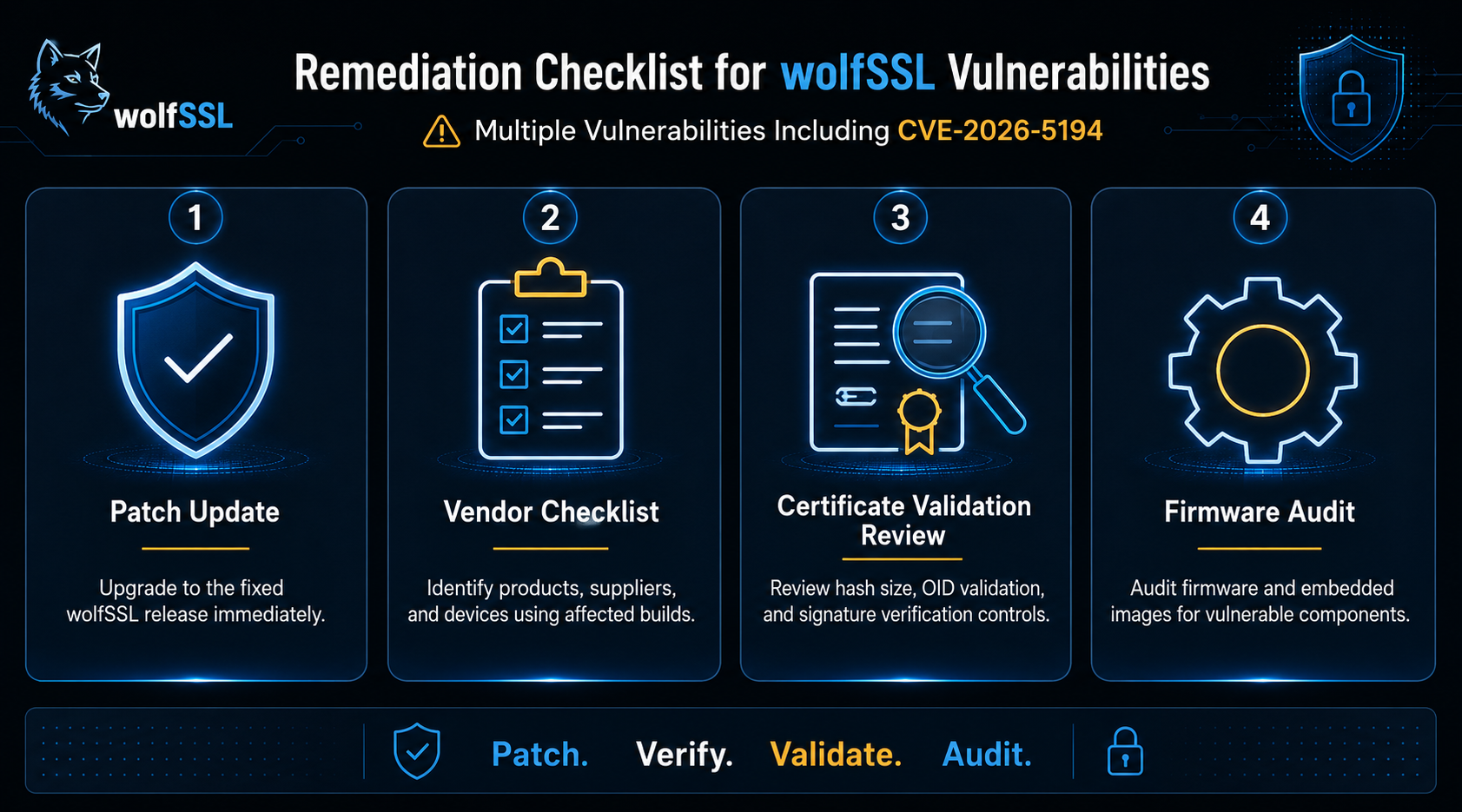
Organizations that build directly against wolfSSL should update to version 5.9.1 or later immediately.
Teams should rebuild any application or firmware image that statically links older wolfSSL versions. They should also update container images, SDKs, build systems, and software dependencies that include wolfSSL.
After patching, teams should verify the runtime version, not only the package manifest. Cached libraries, private copies, or statically linked components can remain vulnerable even after package updates.
Prioritize ECC With EdDSA or ML-DSA Builds
CVE-2026-5194 affects ECDSA/ECC verification when EdDSA or ML-DSA is also enabled. Therefore, security teams should prioritize builds with those combinations first.
This does not mean other wolfSSL updates can wait indefinitely. However, prioritization helps teams focus on the most relevant exposure path.
Teams should review build flags, cryptographic configuration, firmware documentation, and vendor statements to identify high-risk deployments.
If those details are unavailable, treat the product as requiring vendor verification.
Run a Vendor Verification Checklist
Security teams need direct answers from vendors. First, confirm whether the product uses wolfSSL. Then check if the library is dynamically linked or statically linked.
Request the exact wolfSSL version in the shipped build. Also confirm whether ECC, EdDSA, Ed25519, Ed448, or ML-DSA support is enabled.
Next, verify where certificate checks happen. Focus on outbound client connections, mutual TLS paths, firmware update workflows, custom PKI flows, and device management channels.
Finally, request the fixed build number and release date. If the vendor has already patched the issue, ask for release notes or test evidence.
Apply Temporary Mitigations if Patching Is Delayed
Some embedded environments cannot patch immediately. In those cases, teams should reduce risk while they wait for a full fix.
If possible, disable unused certificate verification paths or algorithm combinations that increase exposure. If a separate patched gateway can terminate TLS safely, it may reduce exposure for some architectures.
Network segmentation can also help. Isolate vulnerable devices from untrusted networks and restrict outbound connections to approved destinations.
These steps do not replace patching. They only reduce risk while remediation is pending.
Review Certificate Trust as a Layered Process
Security teams should stop treating TLS as a single checkbox. Trust depends on several checks working together.
Those checks include signature validation, algorithm agreement, digest size enforcement, name validation, hostname verification, revocation handling, certificate constraints, and application-level decisions after verification.
CVE-2026-5194 shows how a small validation gap can weaken the entire trust chain.
For broader technical validation, see Digital Warfare’s <a href="https://digitalwarfare.com/vulnerability-assessments/">vulnerability assessment services</a>.
Inventory Exposure and Preserve Evidence
Inventory comes first. Identify every application, appliance, container, firmware image, and vendor product that uses wolfSSL.
After that, record the wolfSSL version, build flags, vendor response, patch date, and test result for each affected system.
This evidence helps with audits and future reviews. It also helps incident responders confirm which systems were fixed.
A short vulnerability summary is not enough. Verified remediation closes the gap.
For the one external source in this article, review the official NVD entry
Broader Security Lessons From Multiple wolfSSL Vulnerabilities
This disclosure reinforces several important security lessons.
First, embedded software security runs on a different timeline from enterprise software. A patch may ship today, but devices may stay vulnerable for years.
Second, cryptographic validation logic matters as much as the algorithms themselves. CVE-2026-5194 did not break ECDSA as a mathematical algorithm. It broke validation around certificate trust.
Third, AI-assisted vulnerability research is accelerating discovery. Security teams should expect more subtle validation bugs to surface as researchers apply stronger automated analysis to mature codebases.
Finally, downstream verification remains essential. Upstream patches do not automatically fix every vendor product that embeds the vulnerable library.
Why Embedded Software Needs Faster Visibility
Embedded devices create blind spots because they often hide their dependencies. A router, sensor, or appliance may not expose which TLS library it uses.
This lack of visibility slows remediation. It also makes vulnerability management harder because security teams must depend on vendor disclosures.
Organizations should demand better SBOMs, clearer firmware advisories, and more precise vendor communication.
Without that visibility, teams cannot know whether multiple wolfSSL vulnerabilities exist in their environment.
Why Strong Cryptography Still Needs Strong Validation
Strong algorithms do not protect systems when validation logic fails.
Certificate trust depends on strict checks. If a library accepts the wrong digest size or ignores OID agreement, it may trust something that should fail.
Therefore, secure design must include both strong algorithms and careful implementation.
Security reviews should focus not only on which cryptographic algorithms are enabled, but also on how the system validates their use.
Key Takeaway on Multiple wolfSSL Vulnerabilities
Multiple wolfSSL vulnerabilities in version 5.9.1’s security release affects a library used across billions of applications and devices.
The most serious issue, CVE-2026-5194, affects certificate verification through missing hash/digest size and OID checks. Attackers may exploit the flaw to pass forged certificates in affected configurations.
wolfSSL fixed the issue in version 5.9.1. Organizations should update immediately, verify vendor products, prioritize ECC with EdDSA or ML-DSA builds, and review certificate trust paths across embedded systems.
The larger lesson is clear. Security teams must treat embedded libraries as part of the software supply chain, even when those libraries remain hidden inside vendor products.
What Organizations Should Do Now
Start by updating wolfSSL to version 5.9.1 or later wherever your team builds directly against the library.
Next, scan applications, firmware, containers, embedded devices, and vendor products for affected wolfSSL versions.
Give priority to systems that use ECC with EdDSA or ML-DSA enabled. These builds match the highest-risk condition described in the advisory.
Ask vendors for exact fixed build numbers, release timelines, and confirmation of affected cryptographic settings. Do not rely on general statements that say a product is secure.
Use temporary controls where patching cannot happen immediately. Network isolation, restricted outbound access, and patched TLS gateways can reduce risk while a full update is pending.
Finally, preserve evidence of remediation. Keep vendor responses, test results, version records, and patch dates so another engineer can verify the fix later.
Frequently Asked Questions About Multiple wolfSSL Vulnerabilities
What Are Multiple wolfSSL Vulnerabilities?
Multiple wolfSSL vulnerabilities refer to the 21 security issues fixed in wolfSSL 5.9.1. The most serious issue is CVE-2026-5194, a certificate verification flaw involving missing hash/digest size and OID checks.
What Is CVE-2026-5194?
CVE-2026-5194 is a wolfSSL certificate verification vulnerability. Missing digest size and OID checks may allow smaller-than-allowed digests to pass signature verification in affected configurations.
Which wolfSSL Versions Are Affected?
NVD lists affected wolfSSL versions from 3.12.0 up to, but not including, 5.9.1. Organizations should update to wolfSSL 5.9.1 or later.
Why Is CVE-2026-5194 Dangerous?
CVE-2026-5194 is dangerous because it can weaken certificate-based authentication. In affected builds, attackers may be able to pass forged certificates that should have failed verification.
Which Devices Face Risk From Multiple wolfSSL Vulnerabilities?
Potentially affected devices include IoT systems, routers, embedded devices, industrial systems, automotive platforms, aviation systems, and other products that use wolfSSL internally.
Has wolfSSL Patched These Vulnerabilities?
Yes. wolfSSL released version 5.9.1 on April 8, 2026, addressing CVE-2026-5194 and 20 additional security issues.
How Should Organizations Respond?
Organizations should update to wolfSSL 5.9.1 or later, rebuild statically linked software, verify vendor products, prioritize ECC with EdDSA or ML-DSA builds, and review certificate validation paths.
Is There Confirmed Exploitation in the Wild?
The available source material does not confirm active exploitation in the wild. However, organizations should patch quickly because the vulnerability affects certificate trust in widely deployed embedded environments.

